+1 (409) 800-6601
 contact@virtualbuildingstudio.com
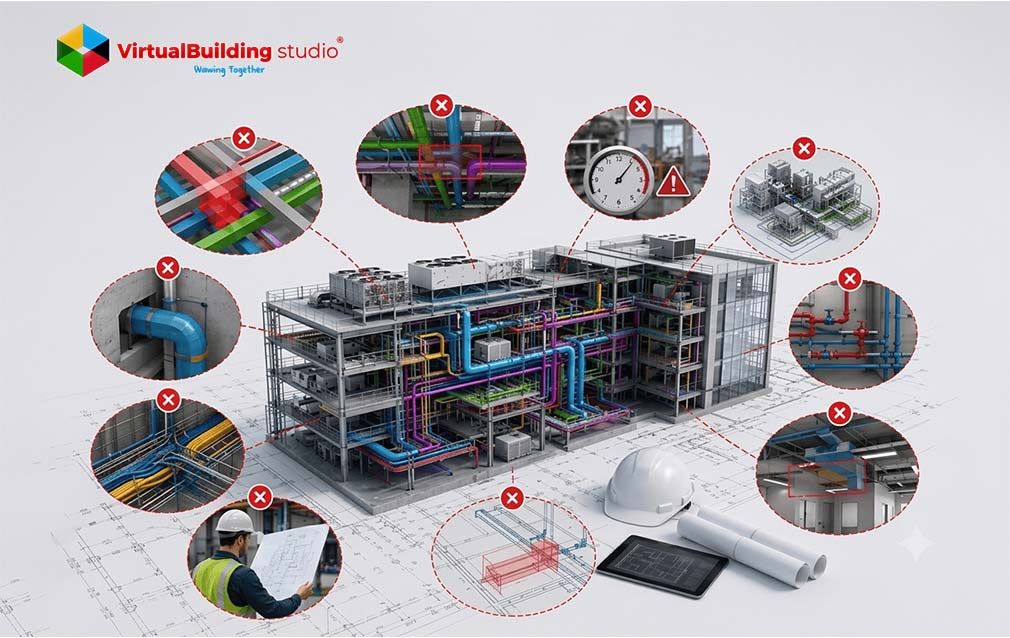
MEP rework accounts for schedule delays of 10 to 70 percent across construction projects, depending on the trade involved. That single number explains why general contractors dread the moment a duct or pipe clash surfaces mid-installation. Most of these conflicts do not originate on site. They originate weeks or months earlier, when a coordination step gets skipped or rushed.
MEP coordination exists specifically to catch these conflicts before crews ever pick up a tool. Yet firms keep repeating the same avoidable errors across projects of every size. Understanding these mistakes is the fastest way for decision makers to protect their schedules and budgets.
Why MEP Coordination Matters for Construction Projects
Mechanical, electrical, and plumbing systems are not a small line item on a drawing set. Research shows MEP work can consume 25-40% of total construction cost and 40-50% of total construction time on service-heavy buildings like hospitals and commercial towers.
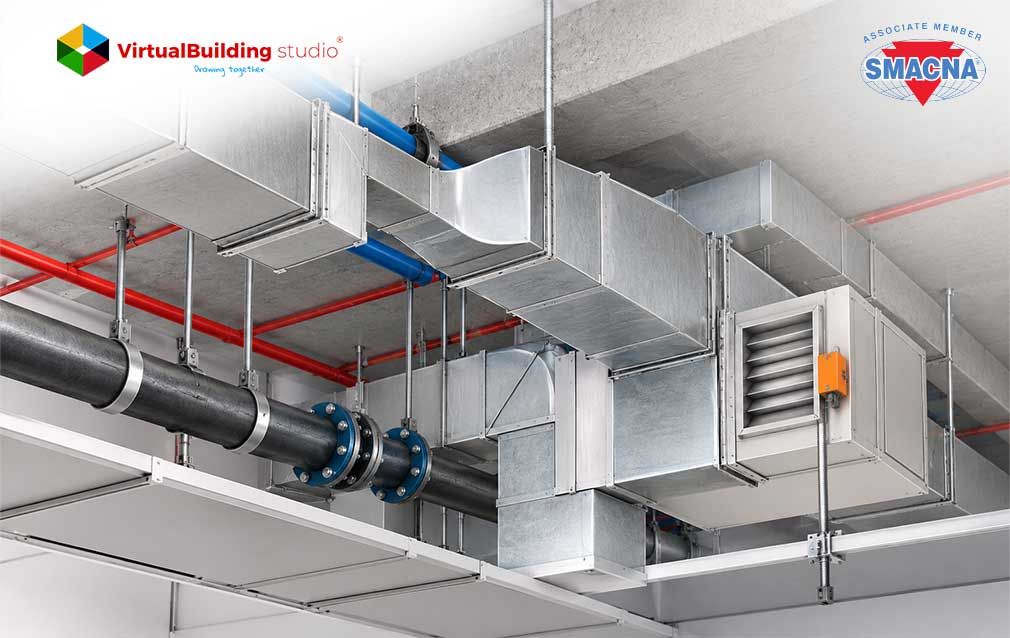
That share explains why one missed clash in a ceiling void can ripple through an entire schedule. Ducts, pipes, and cable trays fight for the same limited space, boxed in by structure and architecture on every side. This is why MEP construction coordination gets harder as service density increases in hospitals, labs, and industrial plants.
Teams that run a disciplined MEP coordination process see design conflicts drop by up to 80% and schedules shrink by 10-30%.Weak coordination produces the opposite result. Rework tied to MEP systems has been linked to schedule delays ranging from 10% to 70%,depending on the trade involved. Many firms now lean on specialized MEP coordination services to manage this complexity alongside their internal design teams.
9 Common MEP Coordination Mistakes That Cause Project Delays and Their Solutions
Early, disciplined MEP coordination can cut design conflicts and shorten schedules. Most project teams never see those results because coordination breaks down in practice. Nine mistakes account for the majority of delays, RFIs, and rework seen on MEP-heavy projects.
These mistakes repeat across firms, project sizes, and building types. Each one starts small, often as a shortcut taken under schedule pressure, and grows into a field conflict that costs far more to fix than it would have to prevent.
Starting MEP Coordination Too Late
Preconstruction is where coordination should happen. Too many projects wait until trades arrive on site to start checking for conflicts. When that happens, a tradesperson holding a pipe that will not fit becomes the clash detector.
Resolving conflicts during the design phase reduces the costs, delays, and disruption that come from on-site fixes and remedial work. Late detection forces teams into a reactive cycle. A clash appears, someone redesigns the route, and a new clash tends to surface elsewhere. This cycle explains why rework tied to poor design-to-construction handoff can add 10-70% to project schedules.
Starting early through a structured BIM execution plan is not optional. It is the difference between fixing a conflict on a screen and fixing it with a grinder on site.
Coordinating Trades in Isolation
HVAC, plumbing, electrical, and fire protection teams frequently develop layouts separately, each focused on their own codes and targets. This is one of the most common failures in MEP construction coordination.
Traditional workflows overlay 2D drawings from each discipline, but overlays frequently fail to catch conflicts hiding in congested ceiling voids and shafts. Field studies comparing manual overlays with automated clash detection found automation catches far more conflicts, yet field observation still turns up issues neither method flagged first. No single trade sees the whole picture alone.
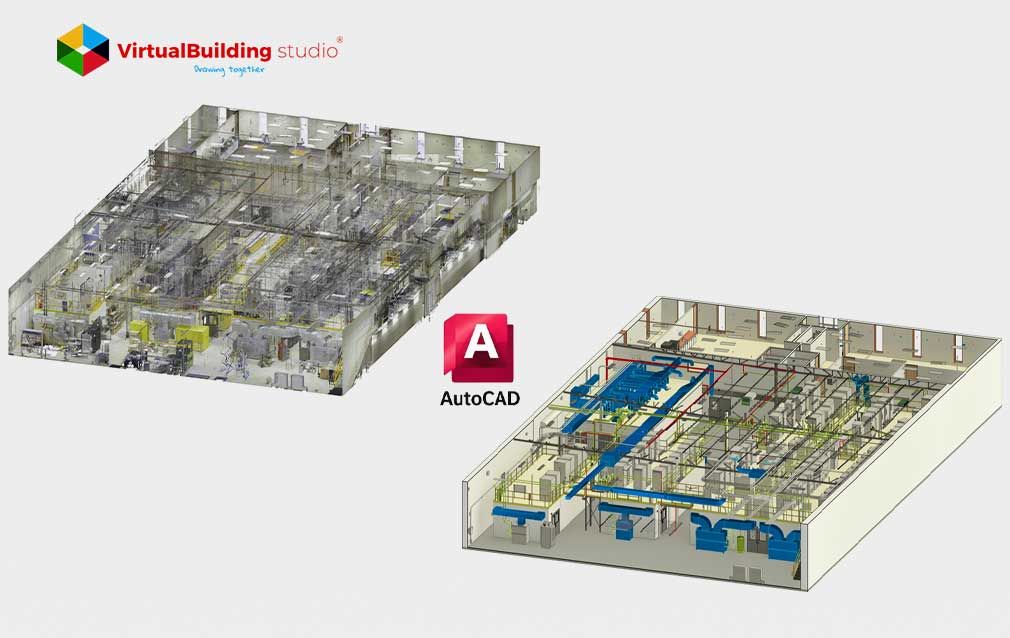
This is why federated coordination models matter. They combine architecture, structure, and every MEP discipline into one aligned 3D environment, letting coordinators see exactly how a duct route crosses a cable tray or a riser. Skipping this step leaves hidden clashes waiting to surface at the worst possible time.
Using Design Models Without Construction Validation
Design models communicate intent, not a guarantee that a component fits on site. Many capture loads and routing concepts but skip installation details like flanges, insulation thickness, or access panels. Coordinating directly off these models means missing the real space a component needs. BIM coordinators must reach at least LOD 300 before running clash detection, because thinner detail produces false positives or hides real conflicts.
Constructability gaps create a quieter category of MEP coordination problems. A pump shown in a plant room might look fine on screen, yet nobody modeled the clearance needed to pull its motor for service.
Separate hard clashes, direct geometric intersections, from soft clearance clashes where a buffer zone gets violated. Both delay projects equally if nobody checks for them before construction starts.
Ignoring Equipment Access and Maintenance Clearances
Major MEP equipment needs room around it for someone to open a panel, pull a filter, or replace a valve. Projects that skip service zone planning let ducts and cable trays fill any open space, leaving nothing for future maintenance.
Rule-based BIM studies show that formally allocating ceiling zones cuts clashes and coordination iterations significantly. Switchboards, air handling units, and condenser units all carry code-mandated clearances that need checking on shop drawings, not just design drawings. Skipping these checks creates MEP coordination problems that surface only once equipment arrives on site. When a cable tray sits too close to a switchboard, the fix means re-routing services mid-installation.
One mixed-reality case study found that visualizing coordinated models on site cut coordination overhead between engineers and crews by up to 75%, and halved issue resolution time. Access planning belongs in the model from day one.
Inaccurate or Incomplete BIM Models
A federated model is only as reliable as the geometry inside it. Strong MEP BIM coordination depends on models reaching at least LOD 300 to capture realistic dimensions and support dependable clash detection. Approximated dimensions throw false alarms for clashes that do not exist, or worse, miss ones that will happen on site. Missing components create a quieter version of the same problem.
One study comparing manual overlays, automated detection, and field observation found clashes involving cable trays went undetected because nobody modeled the trays at all. A model cannot flag a conflict involving an object it never contained. Idealized pipe runs and generic equipment blocks shrink accuracy further.
This is exactly the kind of consistency that reliable BIM coordination for MEP depends on, and a documented BIM execution plan keeps every discipline modeling the same reality.
Poor Clash Prioritization
Not every clash carries the same risk, yet many teams treat all of them with equal urgency. Hard clashes, like a pipe punching through a beam, threaten constructability immediately. Soft clashes involve access or safety buffers, and 4D clashes involve sequencing conflicts between trades working the same space.
A quantitative study on structured MEP clash detection combined with a clash responsibility matrix found it cut design errors by more than 70% and saved close to 30% of project time. Without that structure, coordination meetings drown in low-impact issues while a critical conflict near a structural beam sits unresolved. High-rise case studies show thousands of clashes appearing in a single model, most of them minor.
Teams that classify severity and assign ownership resolve what matters first.
Failing to Coordinate With Structure and Architecture
MEP systems do not exist separate from beams, slabs, and walls. Research on building clashes finds a large share of detected conflicts involve architectural, structural, and MEP elements meeting at the same location, like a duct crossing a column line. Penetrations for ducts and pipes need coordinating with structural engineers before construction, because core drilling into a poured slab later requires approvals nobody budgeted for.
Vertical shafts carry the same risk at a larger scale, holding risers for HVAC, plumbing, fire protection, and electrical systems packed into the tightest space in the building. Unsized or uncoordinated shafts force redesign of entire service stacks once the conflict surfaces.
Coordinating structure, architecture, and every MEP discipline inside one federated model early prevents this kind of late-stage redesign.
Not Updating the Model After Design Changes
A coordinated model only stays useful if it reflects the latest design decisions. Treating the model as a one-time deliverable rather than a living document means resolved clashes can quietly reappear after a design change. Version control keeps every team working from the same source instead of an outdated file.
Change tracking closes the loop. Tools like BCF record which clash was resolved, how, and by which discipline, with timestamps attached. Without that trail, resolved issues resurface unnoticed and disputes over responsibility follow. Maintaining accuracy over a project's life means running clash detection in repeated cycles, not once at the start, and case studies confirm this kind of iterative checking measurably improves model quality.
Treating Clash Detection as the End of Coordination
Generating a clash report feels like progress, but a list of conflicts is not a resolved project. Value comes from resolving clashes through actual design changes, not from counting them. Many projects produce large reports and stop there, with no clear process for assigning responsibility or verifying a fix.
Constructability review picks up where resolution leaves off, checking whether a coordinated layout can be built safely, sequenced properly, and prefabricated where it makes sense. Mixed-reality field studies show comparing coordinated models against actual site conditions catches discrepancies a desktop review alone would miss.
The real goal of MEP coordination for construction is an installation-ready model that trades can build from without guessing.
Best Practices: How MEP Coordination Contractors Can Improve Their Workflow
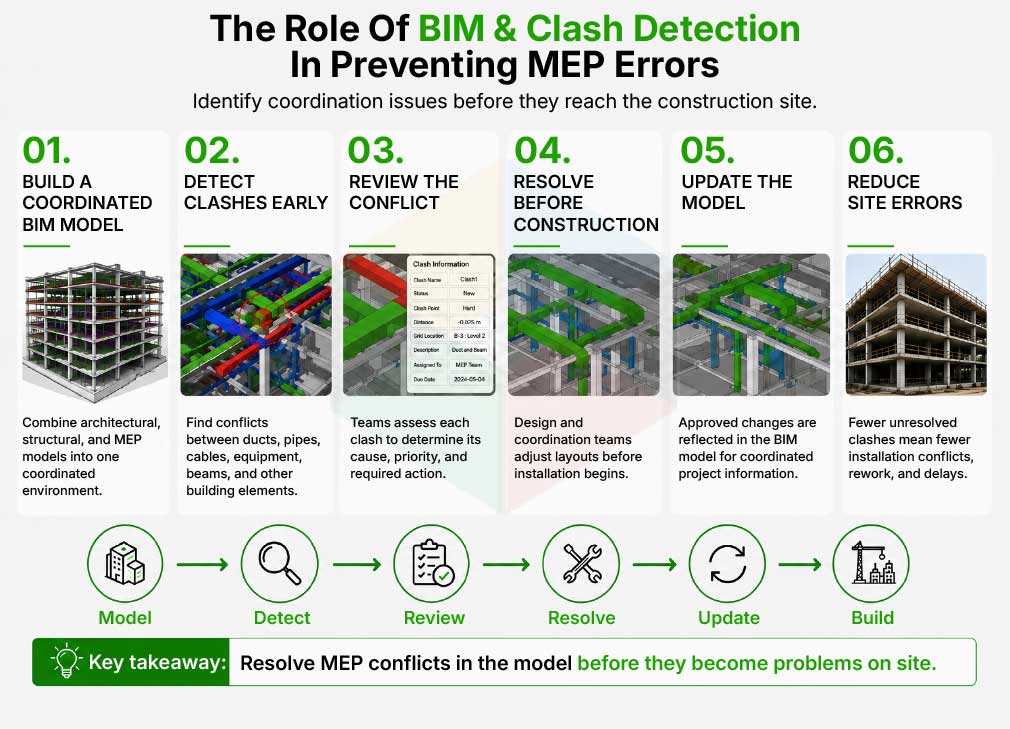
All of the MEP coordination challenges above point to gaps in the MEP coordination process itself. Start coordination during preconstruction and define scope and responsibilities through a BIM execution plan before design work begins. Build every discipline model into a federated model inside a shared data environment, so clash tests run against current information, not outdated files. Standardize modeling practices across teams: consistent detail levels and common naming conventions keep clash reports accurate instead of cluttered with false positives.
Run clash detection as a repeating process:
- Set up clash tests between every discipline pairing
- Classify results by severity and assign ownership
- Resolve, update the model, and retest
- Repeat until conflicts drop to an acceptable level
Many firms bring in dedicated MEP coordination services or an experienced MEP coordination contractor to run these cycles alongside their internal team. Extend the process into constructability review and prefabrication planning, and keep coordinating through construction itself, so the model matches what actually gets built.
Future of AI and Automation in MEP Coordination
Manual clash review does not scale on projects with thousands of potential conflicts. AI-based planning tools are starting to close that gap.
One study across U.S. infrastructure projects found an average schedule overrun of 11%, but higher adoption of AI planning tools correlated with lower delay rates on complex projects.
Applied to BIM coordination for MEP, AI can classify clashes, rank them by priority, and suggest routing based on rule sets for ceiling zones, cutting both conflicts and coordination cycles. Mixed reality closes a different gap, the one between the model and the actual site, letting field teams compare coordinated models against real conditions before issues become RFIs. None of this replaces disciplined modeling. Automation amplifies whatever data goes into it, so a poorly modeled project just produces bad answers faster.
Conclusion
Effective MEP coordination for construction depends on treating it as continuous, not a one-time task before permitting. It runs from early design through the last day of installation. Projects that start early, build federated models, prioritize clashes by real risk, and keep coordinating through construction avoid the bulk of the delays covered here. Projects that skip these steps pay for it later, in RFIs, change orders, and schedules that slip week after week.
Whether the work happens in-house or through an outside MEP coordination contractor, the same discipline applies. The nine mistakes above are avoidable, and fixing them starts with treating coordination as a continuous process instead of a task to finish and forget.

Struggling with MEP clashes and schedule slips? Get your project back on track