2000+
Projects Delivered

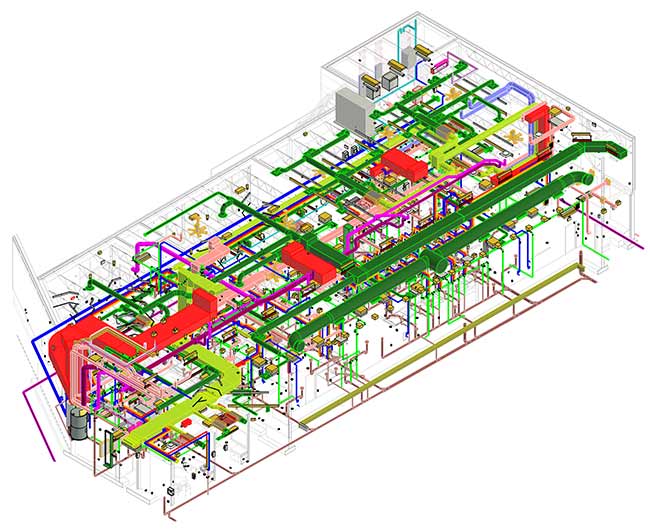
Our BIM experts offer MEP Coordination Services to coordinate all the disciplines ahead of construction to help your team reduce rework, avoid delays, and keep projects on schedule.
2000+
Projects Delivered
300+
Global Clients
11+
Years of Experience
200+
Licensed Engineers
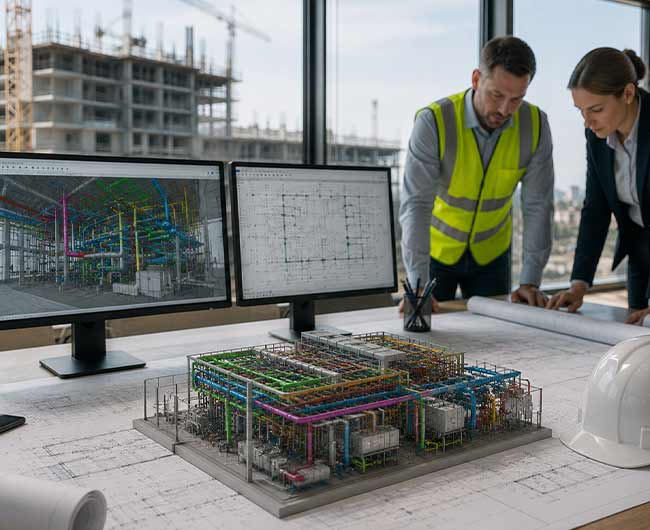
In construction projects, the coordination of MEP systems is necessary to avoid costly installation problems. Design changes, uncoordinated drawings, and unresolved conflicts cause rework, delays, and increased construction costs. Virtual Building Studio is a trusted MEP Coordination Service Provider, providing MEPF Coordination Services in USA, UK, European countries, Australia and Middle east.
Our BIM specialists create synchronized models from LOD 200 to LOD 500 according to SMACNA, NEC, ASHRAE, and project specifications. We offer services that allow accurate fabrication, easier installation and successful field coordination.
Trusted By
Trusted By
Our BIM Coordination Services transform design-intent models into construction-ready coordination deliverables through fully coordinated MEPF Coordination Services built for field execution.

All trade patterns must fit within the building envelope. Our BIM team creates Revit models from LOD 350 to LOD 400 with resolved clashes on MEP (mechanical, electrical, plumbing and fire protection) systems.

Coordination is not just for clash detection. Our specialists review installation sequences, maintenance access and code requirements prior to construction, minimizing RFIs and approval delays.

Big projects produce hundreds of coordination problems. Our team leverages structured Navisworks clash detection workflows to minimize the number of coordination cycles and eliminate unnecessary review meetings between trades.

It costs more to resolve conflicts in the field than in the design office. Our coordination experts locate spatial problems in the BIM model prior to installation, minimizing field changes, change orders, and schedule disruptions.

The fabrication relies on good coordination data. We extract hanger layouts, spool and equipment clearance drawings directly from coordinated BIM models for accurate offsite production.

Successful coordination requires total transparency. All clashes, resolutions and design decisions are logged by our coordinators in structured issue logs with markup, providing all stakeholders with a clear record of coordination.
Our multi-disciplinary coordination workflows improve constructability, sequencing of installation and field level usability for complex commercial and infrastructure projects.
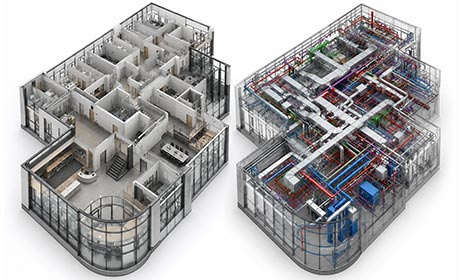
Our team coordinates mechanical, electrical, plumbing and fire protection routing with architectural ceilings, walls, floors and finish clearances according to project specifications.
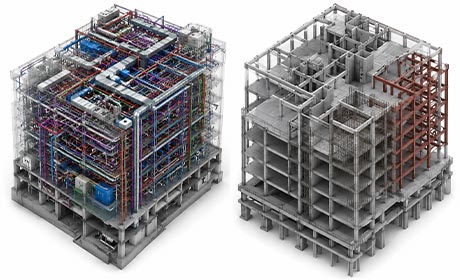
We validate duct runs, pipe sleeves, conduit paths and equipment locations relative to structural beams, columns and slabs with full penetration and sleeve coordination.
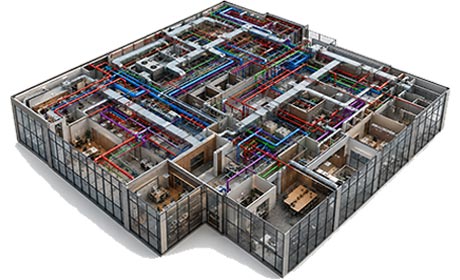
Our coordinators spatially resolve mechanical ductwork, plumbing lines, electrical conduit, and fire suppression piping against one another while maintaining all required clearances.
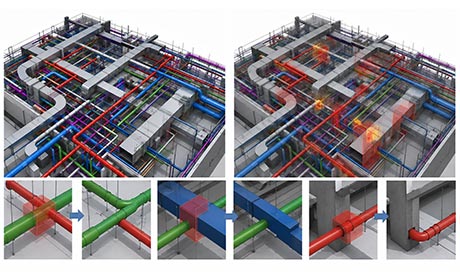
Our team runs Navisworks-based hard, soft, and clearance clash detection per trade, categorizing and tracking every clash to full resolution through structured coordination logs.
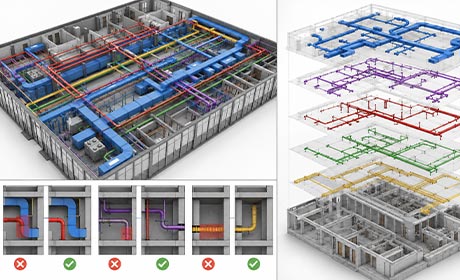
For the routing hierarchy, we established trade prioritization matrices early to efficiently use space and meet installation sequences and maintenance access requirements.
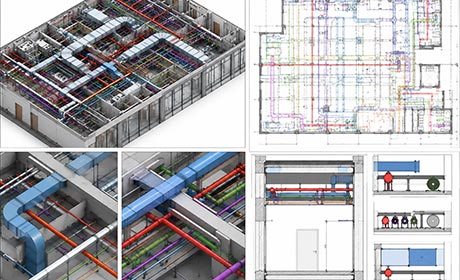
Our experts develop construction-ready drawings from section cuts, plan views and enlarged details extracted from coordinated models for use in the field and by subcontractors.
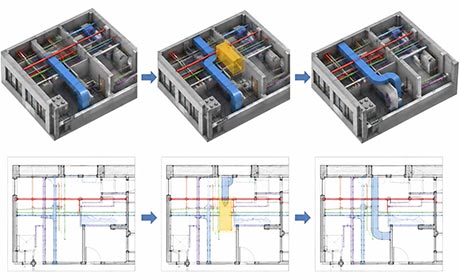
We systematically reintroduce revised architectural, structural, and MEP design inputs into the live coordination model to ensure full integrity throughout the coordination cycle.
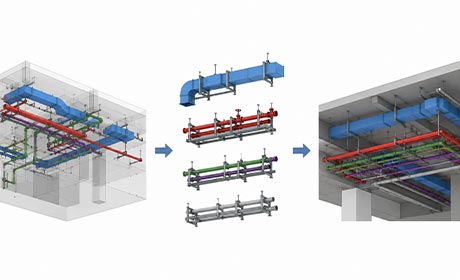
We obtain data from coordinated models on spooling, hanger layouts and offsets in support of off-site prefabrication programs and reduction of on-site assembly time.
What We Deliver with Our MEP Coordination Services
Our deliverables are accuracy-verified, construction-ready, and built to reduce field conflicts, support fabrication, and accelerate project approvals without rework.

Clash-Free Federated Models
Our team develops Navisworks-based integrated models that provide your trades a definitive single source of truth, eliminating onsite spatial conflicts.
Detailed Coordination Reports
Full issue logs and resolution documentation to monitor all clashes from initial detection through to sign off, ensuring full project accountability
BIM-Driven Shop Drawings
Our experts extract high-fidelity 2D drawings from the coordinated model, featuring precise dimensions and professional annotations for immediate, error-free field use.
Bill of Materials (BOM)
We deliver accurate quantity extracts for all MEP components, empowering your team with better cost control and synchronized construction procurement schedules.
Leveraging industry-leading BIM software to create accurate, coordinated, and constructible MEP models for complex projects.
 Autodesk Revit
 BIM 360
 Navis works
 Revizto
Our Process Flow for MEP BIM Coordination Services
A structured coordination workflow that aligns architectural, structural, and MEP systems to provide accurate BIM models, ready for construction.
Kickoff and Intake for New Models
Our team reviews design documents, sets trade priorities, defines coordination zones and sets up the Navisworks clash detection environment.
Kickoff and Intake for New Models
Our team reviews design documents, sets trade priorities, defines coordination zones and sets up the Navisworks clash detection environment.
Development of Individual Trade Model
We model each discipline in Revit to LOD 350 which includes system routing, equipment placement and sleeve locations based on project requirements.
Development of Individual Trade Model
We model each discipline in Revit to LOD 350 which includes system routing, equipment placement and sleeve locations based on project requirements.
Assembly of Federated Model and Conflict Detection
Our coordinators federate all trade models, identify hard, soft and clearance clashes and assign each clash to the responsible teams for resolution.
Assembly of Federated Model and Conflict Detection
Our coordinators federate all trade models, identify hard, soft and clearance clashes and assign each clash to the responsible teams for resolution.
Coordination and Problem Resolution Meetings
We have structured weekly meetings with trade stakeholders to review open clashes and agree on resolutions and assignments for model updates with defined turnaround times.
Coordination and Problem Resolution Meetings
We have structured weekly meetings with trade stakeholders to review open clashes and agree on resolutions and assignments for model updates with defined turnaround times.
Model Updates and Re-Clash Check
Our team updates trade models based on agreed resolutions and re-runs clash detection to ensure all clashes are resolved and no new clashes are introduced.
Model Updates and Re-Clash Check
Our team updates trade models based on agreed resolutions and re-runs clash detection to ensure all clashes are resolved and no new clashes are introduced.
Final Deliverables' Production and Delivery
We deliver clash-free coordinated models, coordination drawings and full issue logs to the GC, sub-contractors and fabrication team.
Final Deliverables' Production and Delivery
We deliver clash-free coordinated models, coordination drawings and full issue logs to the GC, sub-contractors and fabrication team.
Get expert coordination support when multidisciplinary projects require faster issue resolution and reliable model accuracy.

Engage with our expert team to navigate tight plenum spaces and dense MEP requirements, preventing impossible manual detection and structural interferences.

When it’s time to parallel track design and fabrication, our specialists can be a reliable partner for fast, clash-free shop drawing outputs.

Our BIM consultants work with off-site manufacturing projects that require LOD 400 precision to ensure the modules fit perfectly when they arrive.

When your own staff is stretched too thin and you need specialized expertise to efficiently coordinate across disciplines, turn to our seasoned engineers.
Systematic BIM coordination and clash resolution processes lead to improved efficiency, reduced field level conflicts, and accelerated construction workflows.
Early clash detection and coordinated BIM reviews reduces significantly the field changes, materials wastage and repetitive installation corrections on site.
Structured issue tracking and centralized coordination workflows can be effective in speeding up review meetings, approvals and multidisciplinary clash resolution activities.
Installable coordinated BIM models support installation sequencing, reduce site disturbance and facilitate smoother delivery of the project across multiple trades.
Accurate BIM coordination reduces unresolved installation conflicts and reduces coordination of RFIs in the construction and field execution phases.
LOD based coordination workflows greatly improve the accuracy of spools, prefabrication readiness, and alignment between BIM models and fabrication deliverables.
Centralized clash reporting and revision tracking improve communication between stakeholders and speed up coordination decision making between project teams.
Early clash detection and coordinated BIM reviews reduces significantly the field changes, materials wastage and repetitive installation corrections on site.
Structured issue tracking and centralized coordination workflows can be effective in speeding up review meetings, approvals and multidisciplinary clash resolution activities.
Installable coordinated BIM models support installation sequencing, reduce site disturbance and facilitate smoother delivery of the project across multiple trades.
Accurate BIM coordination reduces unresolved installation conflicts and reduces coordination of RFIs in the construction and field execution phases.
LOD based coordination workflows greatly improve the accuracy of spools, prefabrication readiness, and alignment between BIM models and fabrication deliverables.
Centralized clash reporting and revision tracking improve communication between stakeholders and speed up coordination decision making between project teams.