2000+
Projects Delivered

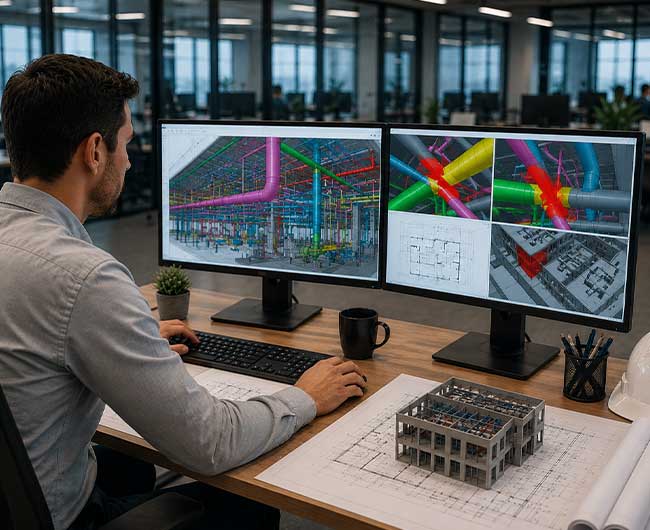
Our BIM Experts provide MEP Clash Detection Services in USA. They help teams coordinate mechanical, electrical, plumbing and fire protection systems early.
2000+
Projects Delivered
300+
Global Clients
11+
Years of Experience
200+
Licensed Engineers
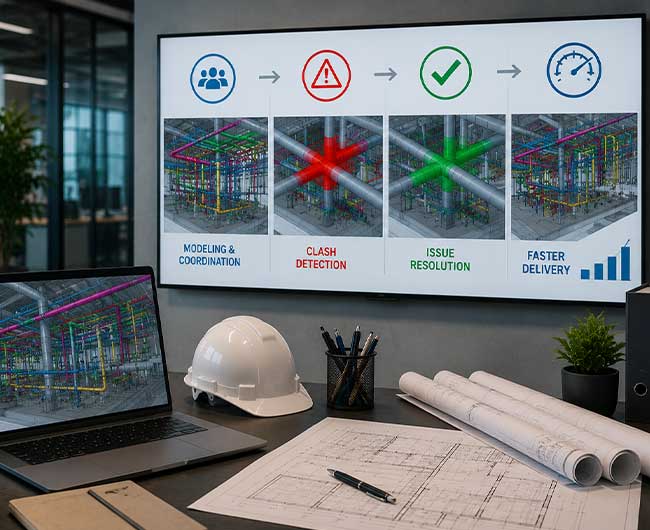
Proper coordination makes sure ductwork, conduits, piping and structural elements don't compete for space. Otherwise, projects suffer rework, delays and cost.
Many firms choose Outsourcing MEP clash detection services when internal teams are stretched. As an experienced MEP Clash Detection Services Provider, Virtual Building Studio assigns US trained BIM specialists to review federated models before installation.
We provide structured Hard and Soft Clash Detection on mechanical, electrical, plumbing, fire protection, structural, and architectural systems and then prioritize issues by severity to enable faster coordination and construction decisions.
Trusted By
Trusted By
Bridge the gap between coordinated BIM models and field-ready construction execution with accurate Hard and Soft Clash Detection workflows.

Our Mechanical Clash Detection process checks HVAC ductwork and hydronic piping for SMACNA standards. The review removes physical intersections before the install reaches the site.

Electrical equipment shall have adequate working space for inspection and maintenance. Our specialists will check NEC clearance requirements to help contractors avoid accessibility issues after installation.

Proper pipe slopes are the key to successful plumbing clash detection. We review the sanitary and domestic piping so that it follows IPC requirements. We verify the adjacent structural and electrical systems.

We take care that the MEP penetrations shall maintain the integrity of fire rated assemblies. We check that routing decisions continue to follow NFPA 101 life safety requirements during coordination.

Seismic support locations compete with MEP systems in dense service zones. We review ASCE 7 bracing requirements and identify conflicts before fabrication begins.

Physical clashes are only one coordination challenge. We also identify workflow conflicts between trades so construction teams can complete installations with fewer site interruptions.
Achieve total project harmony through multi-disciplinary technical depth that transforms complex 3D models into highly functional, field-ready installation guides.
Physical clashes stop construction teams from installing building systems as planned. Our MEPF Clash Detection Services identify direct overlaps between ducts, pipes, conduits, cable trays, structural members and architectural components within federated BIM models. Project teams receive clear clash locations before work reaches the site.
Components may fit within the available space but still fail clearance requirements. Our team identifies maintenance access issues, code required spacing conflicts and equipment servicing limitations. We also check Hard and Soft Clash Detection issues before construction begins. Early reviews help project teams avoid field modifications.
Installation activities depend on the right trade working at the right time. We review construction sequences, installation dependencies and trade workflows to identify conflicts that could delay fabrication, site coordination or project delivery.
What we offer with our MEP clash detection services
Accurate, construction-ready deliverables improve coordination clarity, reduce unresolved conflicts, and support faster decision-making across project stakeholders.

Mechanical Clash Detection
Our Mechanical Clash Detection deliverables are HVAC and piping models coordinated and verified against SMACNA standards. Layouts with fewer conflicts in installation and clearer routing paths are provided to contractors.
Electrical Clash Detection
Our clash detection services for electrical systems include coordinated conduit and cable tray layouts to follow NEC clearance requirements. The clash report also points out interference with structural and architectural elements before installation.
Plumbing Clash Detection
Our Plumbing Clash Detection deliverables include coordinated domestic and sanitary piping models that adhere to IPC slope requirements. Each review considers the adjacent mechanical, electrical and structural systems to minimize routing conflicts.
Clash Reports & Tracking Logs
All coordination cycles include Navisworks clash reports, viewpoints and tracking logs. The project teams can see each issue during the coordination process, assign ownership, track progress and verify resolution.
Leveraging industry-leading BIM software to create accurate, coordinated, and constructible MEP models for complex projects.
 Autodesk Revit
 BIM 360
 Navis works
Our Workflow for MEP Clash Detection Services
A structured six-step process that detects and resolves MEP clashes early, improving coordination, constructability, and project efficiency.
Model Collection and Validation
Our specialists check Revit and IFC models to confirm file integrity and that the right project coordinates are applied to each discipline.
Model Collection and Validation
Our specialists check Revit and IFC models to confirm file integrity and that the right project coordinates are applied to each discipline.
Automated Detection
We use Navisworks and Solibri to run systematic hard, soft and clearance clash detection for all project disciplines.
Automated Detection
We use Navisworks and Solibri to run systematic hard, soft and clearance clash detection for all project disciplines.
Clash Grouping
Our team then removes duplicate results and false positives, and clusters related clashes into manageable coordination issues.
Clash Grouping
Our team then removes duplicate results and false positives, and clusters related clashes into manageable coordination issues.
Coordination Meetings
Project leads meet on a regular basis to coordinate responsibilities, discuss solutions and resolve high-priority conflicts.
Coordination Meetings
Project leads meet on a regular basis to coordinate responsibilities, discuss solutions and resolve high-priority conflicts.
Tracking Resolution
Our experts review the updated models and run the clash tests again to make sure the problems have been solved. And then again check later for any new conflicts introduced.
Tracking Resolution
Our experts review the updated models and run the clash tests again to make sure the problems have been solved. And then again check later for any new conflicts introduced.
Final Co-ordination Outputs
We develop coordinated BIM models, clash reports, viewpoints and tracking documentation for construction, fabrication and project execution.
Final Co-ordination Outputs
We develop coordinated BIM models, clash reports, viewpoints and tracking documentation for construction, fabrication and project execution.
Work with dedicated coordination experts when project complexity, deadlines or internal resource constraints begin to affect model quality.

Construction documents need coordinated models before they reach the field. Outsourcing MEP clash detection services gives your team an independent review before issuing construction drawings.

Fabrication starts with coordinated models. We review MEP systems before release so fabricators get models with fewer unresolved clashes and routing conflicts.

Design changes involving many disciplines can create new coordination problems. We take a look at the revised routing, new conflicts and then move on with updated models.

A growing number of installation RFIs usually points to coordination gaps. We review the latest models to identify root causes and reduce repeated field conflicts.

Building services become harder to coordinate as project density increases. Our specialists review high-congestion areas to help project teams maintain constructability across every discipline.

Project workloads change throughout the year. As an experienced MEP clash detection services provider, we work as an extension to your BIM team when additional coordination support is needed.
Maximize your project ROI and operational efficiency through a rigorous BIM coordination process that eliminates field waste and schedule delays.
During preconstruction stage identification of coordination issues reduces time spent by field crews on resolving installation conflicts. That cuts down on change orders, material waste and rework.
Well structured clash reviews allow project teams to discuss issues earlier and make decisions with less coordination meetings.
Accurate hard and soft clash detection solves many coordination problems before construction starts. Project teams spend less time solving installation related RFIs.
Coordinated routing makes installation activities smoother. Trade teams can get work done with less interruption from competing building systems.
Fabricators need coordinated models prior to starting production. Early conflict resolution minimizes model revision during fabrication planning.
Good MEP layout designs can maximize the use of ceiling space and still provide access and clearance for equipment maintenance throughout the building.
During preconstruction stage identification of coordination issues reduces time spent by field crews on resolving installation conflicts. That cuts down on change orders, material waste and rework.
Well structured clash reviews allow project teams to discuss issues earlier and make decisions with less coordination meetings.
Accurate hard and soft clash detection solves many coordination problems before construction starts. Project teams spend less time solving installation related RFIs.
Coordinated routing makes installation activities smoother. Trade teams can get work done with less interruption from competing building systems.
Fabricators need coordinated models prior to starting production. Early conflict resolution minimizes model revision during fabrication planning.
Good MEP layout designs can maximize the use of ceiling space and still provide access and clearance for equipment maintenance throughout the building.