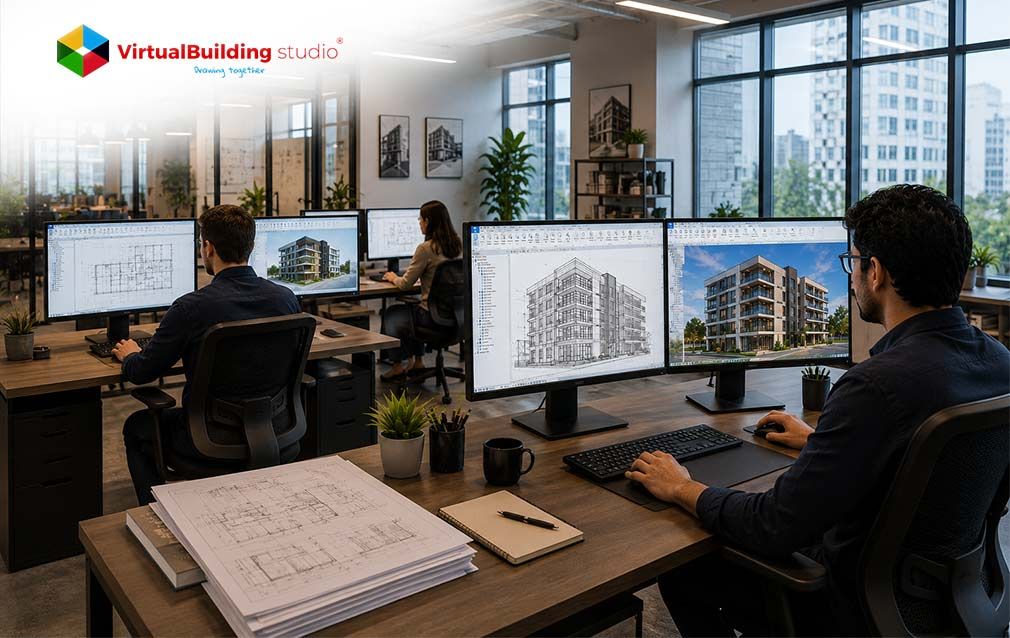
AEC firms across the US are turning away project bids they would have accepted five years ago. The reason isn't a lack of demand. It's a shortage of BIM-trained staff who can carry a Revit model from concept through construction documentation. Software licenses, workstations, and ongoing training add real cost to every in-house hire, and none of that spending flexes when a project pipeline slows down.
This capacity gap is why Revit outsourcing has moved from a stopgap measure into a standard part of how AEC firms plan their staffing. Instead of hiring for peak workload and carrying idle capacity during slow months, firms bring in specialized modeling teams exactly when a project needs them. Academic surveys among general contracting enterprises reveal that around 45% of firms actively outsource key BIM functions to specialized service providers.
This blog looks at what the practice actually involves, the services firms typically hand off, what it costs, and how to pick a partner who won't create more problems than they solve.
What Is Revit Outsourcing?
Revit outsourcing means handing BIM authoring, parametric content creation, multi-disciplinary coordination, and construction documentation to a specialized external team. It differs from old-style CAD outsourcing, which only moved static line-work between firms.
Every element inside a Revit model carries live data. Change a wall's height in a 3D view, and floor plans, elevations, sections, and schedules update automatically across the shared file. External teams working on Revit outsourcing Services build these intelligent components the same way an internal team would, following the client's naming conventions, parameters, and modeling standards.
Firms typically choose between three delivery structures:
- In-house execution - Full control, but high fixed costs for software, hardware, and training.
- Hybrid outsourcing - Internal leads direct external specialists on specific disciplines or deliverables.
- Full outsource execution - The vendor handles production while internal staff manage design intent and client relationships.
Most firms land in the hybrid model, since it keeps design decisions internal while shifting repetitive modeling work externally. Understanding these delivery structures only matters once firms understand why Revit itself has become the backbone of modern project delivery.
Why Revit Is Important for the AEC Industry
Building Information Modeling stopped being optional once public agencies and private developers began requiring digital deliverables at every project stage. Revit sits at the center of that shift because of how it stores and connects information.
Traditional CAD drawings are just lines and arcs with no data behind them. Revit elements carry geometry, material specs, manufacturer data, and spatial relationships in a single database. When a structural engineer resizes a column, the change propagates through framing plans, connection details, and material takeoffs without manual redrafting.
That same database structure supports coordination across disciplines. Architectural, structural, and MEP models get federated into one spatial environment, where clash detection tools catch conflicts on screen instead of on the job site. Firms use this coordination to cut down on change orders and rework that used to be routine.
Revit's usefulness also extends across project all BIM dimensions from 3D to 7D. This range of functions is exactly why outsourcing providers now cover the full project lifecycle instead of just early design modeling. This raises the question of what those services actually look like in practice.
Revit Outsourcing Services for AEC Firms
The scope of Revit outsourcing Services covers every phase from concept sketch to facility handover. Firms typically outsource one or more of the following:
- Architectural modeling: Turning concept sketches or 2D PDFs into full construction document sets, including floor plans, reflected ceiling plans, elevations and schedules. This is the core of most Revit architectural BIM services engagements.
- Structural modeling and detailing: Foundation systems, precast components and structural steel framing, including rebar detailing and fabrication shop drawings at higher LOD tiers.
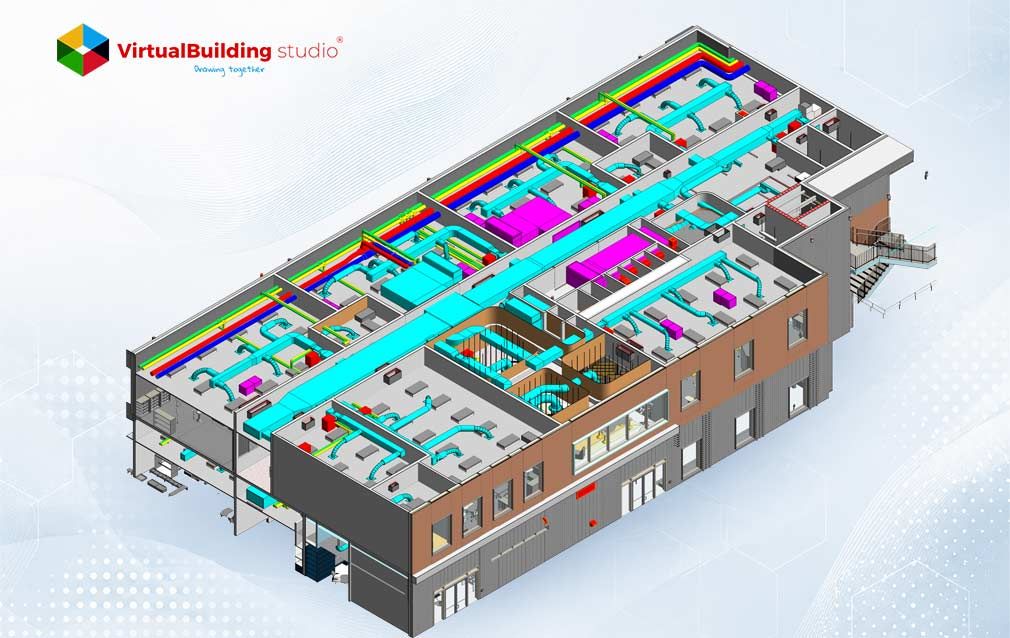
- MEP modeling: HVAC ductwork, piping, electrical conduit and equipment layouts, coordinated to avoid spatial clashes before installation begins.
- Revit family creation: Building custom, intelligent 3D content libraries with embedded parameters, type catalogs and metadata like COBie attributes. Firms and product manufacturers both rely on outsourced Revit family creation to standardize their content libraries.
- Scan to BIM conversion: Turning laser scan point cloud data into accurate as-built Revit models for renovation, expansion or preservation projects.
Each of these deliverables can be scoped independently, which is why firms often start with one service and expand the engagement once the vendor proves reliable. Once a firm sees the range of what a vendor can take on, the natural next question is what tangible advantage that partnership actually delivers.
Benefits of Revit Outsourcing
Cost is the most cited reason firms explore outsourcing, but it isn't the only one.
Cost structure changes
In-house BIM studios carry fixed costs for software seats, workstations, and benefits regardless of workload. Outsourcing turns that fixed cost into a variable expense tied directly to project billing. Academic research on AEC outsourcing decisions points to lower production costs as one of the top drivers behind the shift.
Capacity becomes elastic
Project volume moves in cycles, with heavy demand during bids and design phases. Revit outsourcing for AEC gives firms a way to scale modeling capacity up or down without long-term payroll commitments.
Access to specialized skill sets expands
Vendors focused exclusively on Revit modeling services carry deeper knowledge in Dynamo scripting, MEP clash resolution and international standards like IBC than a generalist internal team.
Production runs around the clock
When a US firm partners with an offshore team, redline markups sent at the end of the workday get processed overnight and returned by morning.
Internal staff stay focused on higher-value work
Production drafting can consume 60-70% of an internal team's billable hours. Offloading that work frees senior architects and engineers for design innovation and client management.
None of these advantages show up automatically. They depend entirely on how the outsourcing engagement is structured and run day to day
Revit Outsourcing Workflow
None of these benefits materialize without a structured process. Most engagements follow ISO 19650, the international standard for managing information across a building's lifecycle.
The process starts with a BIM Execution Plan. Before any modeling begins, the client and vendor define Level of Development milestones, software version controls, shared coordinate systems, and naming conventions in this document.
Next both teams establish a Common Data Environment on a cloud platform such as Autodesk Construction Cloud. Within that environment, files move through four defined states:
- Work in Progress: The Revit BIM company’s internal authoring space, inaccessible to other disciplines until it clears internal review.
- Shared: Other disciplines receive read-only access for coordination and clash detection after the model passes lead review.
- Published: This model is the contractual base for construction and procurement after formal authorisation
- Archived: Superseded files are moved here with a full audit trail for compliance and dispute resolution.
QC process runs in parallel with this workflow. Scripts for model health and clash detection routines in Navisworks. It flags conflicts for resolution before drawings go out. This structure stays consistent across every project, but the deliverables it produces shift depending on which AEC professional is requesting them.
Revit Outsourcing for Different AEC Professionals
The workflow above stays consistent, but the deliverables shift depending on who's requesting them.
Revit services for architects
Architects use Revit modeling services to convert early concepts into production ready documentation. Typical deliverables include permit drawing sets, interior elevations with custom FF&E families and coordinated door and window schedules.
Revit services for engineers
Structural teams get framing plans, anchor bolt layouts, and rebar detailing with automated bending schedules. MEP teams get duct sizing, piping layouts, and conduit routing resolved for clashes before installation.
Revit services for contractors
Specialty contractors, GCs and VDC managers use Revit BIM services to bridge the gap between design and construction. This includes:
- Elevating models to fabrication-level detail for shop drawings
- Building 4D sequencing simulations tied to project schedules
- Running scan to BIM audits to deliver verified as-built models to owners after completion.
With these role-specific deliverables clear, the practical question every firm asks next is what all of this actually costs
How Much Does Revit Outsourcing Cost?
Pricing depends on geography, project complexity, and the engagement structure a firm chooses.
Hourly charge
It’s perfect for projects with a changing scope and the client pays for actual hours. This offers flexibility but less budget certainty.
Fixed price contracts
One price for a well defined scope, for example converting finished CAD set to an LOD 300 Revit. For firms that lock down project parameters, this model removes budget surprises.
Dedicated resource retainer
A monthly fee-based engagement model involving a dedicated external team working on client-controlled daily task assignments. This works best for firms with continuous project pipelines rather than one-off jobs.
Several factors push costs up or down within each model:
- Level of Development required, since LOD 400 fabrication detail takes far more labor than LOD 200 schematic work
- Discipline density, with MEP coordination typically requiring more hours than standard architectural modeling
- Source data quality, since clean CAD files need less conversion work than degraded scans or hand sketches
- Turnaround requirements, where compressed schedules can add surcharges for multi-shift production
Knowing what drives the price only helps if a firm can also confirm the vendor charging it can actually deliver on quality and standards.
How to Choose the Right Revit Outsourcing Partner
Cost estimates only matter if the vendor can actually deliver. Before signing a contract, firms should run through five checks.
- Audit the native files first
Ask for sample RVT files rather than static PDF exports. A senior BIM manager should review these for clean family construction, proper workset organization and low warning counts.
- Confirm standards compliance
A qualified Revit BIM services provider should show documented experience managing work in progress, shared, published and archived states within ISO 19650 workflows.
- Verify security controls
Building models contain sensitive commercial data. Vendors should carry Non-Disclosure Agreement, ISO 27001 certification and role based access control on project files.
- Test communication and time zone overlap
Make sure the provider uses structured issue tracking tools like BCF workflows not scattered email threads for coordination.
- Run a paid pilot before committing long term
A small project, such as converting a schematic design into an LOD 200 model, reveals modeling speed, accuracy and responsiveness under real conditions.
Choosing a partner well solves today's staffing gap, but firms also need to know how this relationship is likely to change as the technology behind it keeps advancing.
Future of Revit Outsourcing in the AEC Industry
The workflows described above are already shifting as new tools enter production pipelines.
- Automation is changing how models get built. Vendors increasingly use Dynamo scripts and Python-based tools to automate repetitive tasks like room layout generation and rebar placement, cutting production time while reducing manual errors.
- Cloud co-authoring is replacing file transfers. Client teams and outsourced specialists now work inside the same central file simultaneously. They use platforms like Autodesk BIM Collaborate Pro instead of exchanging files back and forth.
- Computer vision is speeding up reality capture. Machine learning tools now process laser scan point clouds and automatically identify walls, columns and MEP runs, shortening the time between a site scan and a usable as-built model.
- Digital twins are becoming a standard deliverable. Revit service providers enrich LOD 500 as-built models with IoT sensor feeds and building management data. LOD 500 models give owners live visibility into asset performance after handover.
- Sustainability tracking is moving earlier into design. Outsourcing teams now embed carbon and energy data directly into parametric families, supporting LEED and net-zero certification goals from the schematic phase onward.
These shifts point toward a clear direction for the industry, one worth pulling together before deciding how a firm should act on it.
Conclusion
The AEC sector has reached a point where high-precision BIM isn't optional for firms competing on complex projects. Maintaining a fully in-house modeling studio for every workload spike creates cost and capacity problems that most firms can't sustain long term.
Revit outsourcing for AEC addresses this directly, giving firms elastic capacity, access to specialized technical skills, and lower fixed costs without sacrificing model quality. The firms getting the most value from this approach treat it as structured practice rather than emergency overflow. That means formal BIM Execution Plans, ISO 19650-compliant data environments, consistent QA/QC audits, and vendor selection based on verified technical evidence rather than a sales pitch.
Firms that build this discipline into their outsourcing relationships end up with faster production, lower overhead, and more internal time for the design and client work that actually grows the business.
Ready to scale your BIM production without adding Revit headcount?