+1 (409) 800-6601
 contact@virtualbuildingstudio.com

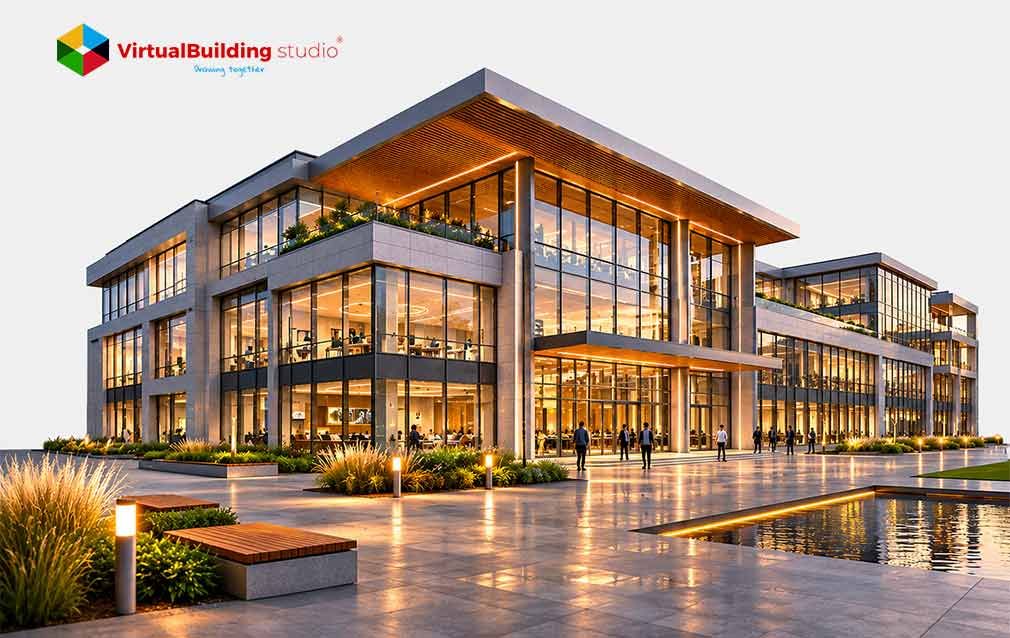
Most clients see a design presentation and still cannot imagine the building. They get four or five polished stills, and they nod along. Then they ask the question that every architect has to ask: what will it actually feel like inside? When clients can’t visualize the space, firms lose approvals, buyers, and weeks of back-and-forth.
Companies have been trying to fill this gap with better renders. They honed materials and tidied up lighting, but clients still saw one angle at one hour in each picture. As a result, companies turned to the cinematic and video game industries for their experience. They relied on the moving camera and sound techniques to present space evolution in time.
This shift is altering the way US firms are looking at architectural visualization as a whole. Clients see one cinematic presentation, and they expect the next one to be moving and moody, too. So, it’s worth being precise about what ‘cinematic’ means here.
What is cinematic architectural visualization?
The main aim of rendering is the accurate reproduction of objects and materials. Many people believe that the render’s quality can be evaluated by the appearance of bricks as bricks or glass representing the sky. Indeed, this is true, but only as concerns the visual part of architecture.
Cinematic architectural visualization supplies the missing piece: the feeling of the building. Artists borrow techniques from film and game production to create an atmosphere, emotion and story, around their design. In practice they deal with things as:
- Camera paths planned shot by shot, the way a film director plans them
- Depth of field that pulls the viewer's focus toward one detail
- Weather, fog, and light that change across a scene
- Sound, people, and movement that make the space feel lived in
The hope is that viewers will get a sense of what it's like to be in that lobby at 8 a.m. on a rainy Tuesday. Now, the studios offering 3D Rendering Services plan these details from the very first storyboard. But it took years of changes in hardware and workflow for the industry to reach that point.
From Static Renders to Cinematic Architectural Visualization
Those changes began with a very different daily routine. For years architectural rendering services have been done on offline render engines that tie up a computer for hours at a time. Throughout the day, artists changed the lighting and materials and waited overnight for a finished image. The standard deliverable was 3-5 polished views; each locked to a single camera angle.
That was fine when clients only wanted a few hero shots. As graphics cards got more powerful and cheaper, it started to fall apart. Game engines such as Unreal Engine and Unity have added better lighting and real-time ray tracing. Now mid-size firms can suddenly produce slick animation that once required a film studio budget.
But early animations had their own problems. Most firms produced generic fly-throughs that circled the model and left the viewer a little dizzy. Specialist rendering studios responded by becoming more like film crews. Now they’re planning short films with:
- Shot lists and deliberate camera direction
- Color grading that sets the mood
- Sound design
- People and everyday activity in the scenes
When the studios could make real films, not fly-throughs, a larger question developed. Why did the clients want them so badly all of a sudden?
Why Architectural Visualization Is Becoming Cinematic
That question’s answer is persuasion. Developers, city councils and community boards are evaluating proposals with eyes schooled in streaming shows and video games. They look at a flat, poorly lit rendering of a $50 million project, and they read that as a weaker project.
Architects have translation problems, too. Their BIM models have detailed technical data that most stakeholders are unable to read. Using cinematic presentations, architects can make that data into a short film that a council member or investor can follow.
Here's how the two approaches compare from the client's seat:
For firms chasing competitive work, clients notice that difference right away. That's why more firms now hire Architectural Visualization Services that think like filmmakers. And among all the film techniques those teams borrow; motion does the heaviest lifting.
How Motion Transforms Architectural Storytelling
In a static image, all viewers get to see the entirety of the whole frame, and they can direct their gaze at any point they want to. Motion returns the control to the designer. In case of architects, 3D rendering implies that the designer chooses what comes first in the view of the audience. The designer also has control over audience’s time and movement.
Designers borrow a few camera moves from film to guide that attention:
- Slow pans that follow the sweep of a staircase
- Tracking shots that carry viewers across a plaza at walking pace
- Rack focus that shifts attention from a handrail detail to the view beyond it
The cost of experienced 3D rendering services is in planning those moves before anyone renders a single frame.
Artists can also show how the environment changes over time. There are also trees blowing in the wind, people walking across the courtyard and a time lapse from day to nighttime. Clients see more than a shape on a lot. They get a sense of how the occupants will use the place down the line.
But there is one limitation to directed movies. They can’t go off the path the director laid out, but clients watch them.
The Role of Real-Time Rendering and Interactive Visualization
Firms get past that limit with real-time rendering. Engines like Unreal Engine, Lumion, and Enscape let artists see lighting and reflections update instantly. That speed lets clients stop watching and start exploring the model themselves.
Adoption has moved quickly. Chaos and Architizer surveyed 2,139 design professionals in 2023, mostly at US firms. 77% said their firm uses real-time rendering at least twice a week.
During a meeting, architects can also make live changes while everyone in the room watches:
- Shift the time of day to test sunlight
- Swap flooring, cladding, or paint finishes
- Move a wall and see the new room right away.
Architects get the most out of interactive architectural visualization when the engine links to their BIM model. Plugins for Autodesk Revit let them push design updates straight into the presentation. Clients can then settle questions in one meeting instead of waiting on another round of renders.
Speed in the meeting is only half of the story, though. Speed in production is where the newest tools come in.
AI and Automation in Cinematic Architectural Visualization
Production work has always included slow, repetitive steps. Artists clean up image noise, upscale frames, and hand-place thousands of trees and people. On a multi-minute film, those hours add up fast.
Software developers now build AI tools to take over those steps. AI architectural rendering tools help artists:
- Remove noise from frames as they render
- Upscale low-resolution renders to 4K
- Generate background scenery from a short text prompt
- Fill a scene with region-appropriate plants and varied crowds
Designers have picked these tools up fast. In the same Chaos and Architizer survey, 55% of respondents said they already use AI in their visualization work.
Most artists use AI in architectural visualization as a productivity tool rather than a replacement for creative decision-making. They still pick the shots, the mood, and the story. The hours saved on cleanup go into creative direction. Small companies can now make movies that used to require a big studio budget.
All that production effort pays off only if clients actually engage with the result.
How Cinematic Visualization Improves Client Engagement
Most clients are not architects and cannot read floor plans. They look at the 2D drawings and they nod their heads, but they don’t really understand the space until it’s built. Then they come back and want changes and the later the changes the more they cost.
Architects feel the cost of that gap across the whole industry. A 2018 Autodesk and FMI study found that poor project data and miscommunication cause 48% of US construction rework.
Cinematic presentations help architects close that gap early. Clients experience the scale, light, and materials before anyone pours a foundation. When they understand the design, they raise concerns while changes are still cheap.
Clear visuals also build trust between architects and their clients. In AEC forums, principals point to cinematic presentations as a key reason approvals and pre-sales move faster. Developers see the same effect with buyers who can't visit a finished unit yet.
Better engagement has pushed firms to try visualization in places beyond the pitch meeting.
Key Trends Shaping the Future of Architectural Visualization
So far, most of these changes have happened inside presentations. The next set of trends carries cinematic work further into how buildings get designed, sold, and run:
- Cloud rendering and pixel streaming. Firms and architectural visualization services host heavy cinematic models on cloud servers. They stream those models to any device. Clients can explore a detailed model on a phone or an older laptop.
- Digital twins. Completed buildings are being linked with real-time sensor data by owners with 3D architectural visualization models. Facility managers can then monitor energy use and occupancy in a familiar, game-like display.
- More output, fewer teams. As AI architectural rendering improves, smaller firms will be able to produce more film-quality output without hiring more people.
- Falling back to real-time. Today's firms are using interactive architectural visualization as a daily design tool, not an end-of-the-line add-on.
All these trends lead in the same direction. Clients are moving from seeing a building to being in it.
The Future: From Architectural Visualization to Immersive Experiences
Today, most cinematic work still plays on a flat screen. Clients watch a film or click through a model on a monitor. Designers are now moving that work into AR and VR headsets as the hardware gets lighter and sharper.
Inside a headset, clients walk through a full-scale model of their own project. They can hear how a carpet softens footsteps or check how afternoon sun hits their desk. Every lighting and sound choice the artist makes now surrounds them.
That changes what 3D rendering for architects means as a job. Firms will design experiences people move through, instead of images people look at. Cinematic architectural visualization already gets clients used to experiencing a space before it exists. That makes it the natural bridge to this future.
Conclusion
It's never been easy for clients to picture future buildings. Conventional renders have offered them an image of a structure but have only given a single instance of it. Cinematic technology allows architects to utilize cinematic solutions, just like filmmakers do: techniques that include motion, emotion, speed, and plot. Real-time technology has made it possible for clients to investigate a project and make changes right away. Moreover, artists are using artificial intelligence in the process of architectural visualization to minimize the time it takes to produce a project.
The implication for firms is practical. Your clients are comparing your presentation to everything else they see on the screen. If the next pitch, council hearing or pre-sale campaign depends on people feeling the space, plan it like a movie. Start with one project and go with architectural rendering services that offer real cinematic production.

Still pitching with four still renders? Give your client a film they can approve on the first watch