+1 (409) 800-6601
 contact@virtualbuildingstudio.com
Construction projects generate large volumes of information. That data must remain consistent across design, coordination, documentation and construction. As project complexity increases, even small inconsistencies between models, drawings and schedules can create delays, RFIs and costly rework. BIM helps project teams maintain a single source of truth. But the quality of that environment depends on the quality of the objects inside it.
This is where Revit family creation services become important. Intelligent, information-rich BIM objects help teams manage information consistently. They support coordination efforts and helps in digital construction workflow optimization
What Is Revit Family Creation in BIM?
Since BIM relies on intelligent objects rather than simple geometry, the quality of those objects directly affects project outcomes. Revit family creation is the process of developing the building components used throughout a Revit model.
A Revit family combines geometry, parameters, constraints, and metadata into a single object. Instead of functioning like a traditional CAD block, a family can store more. Families contain dimensions, materials, classifications, manufacturer information and performance data.
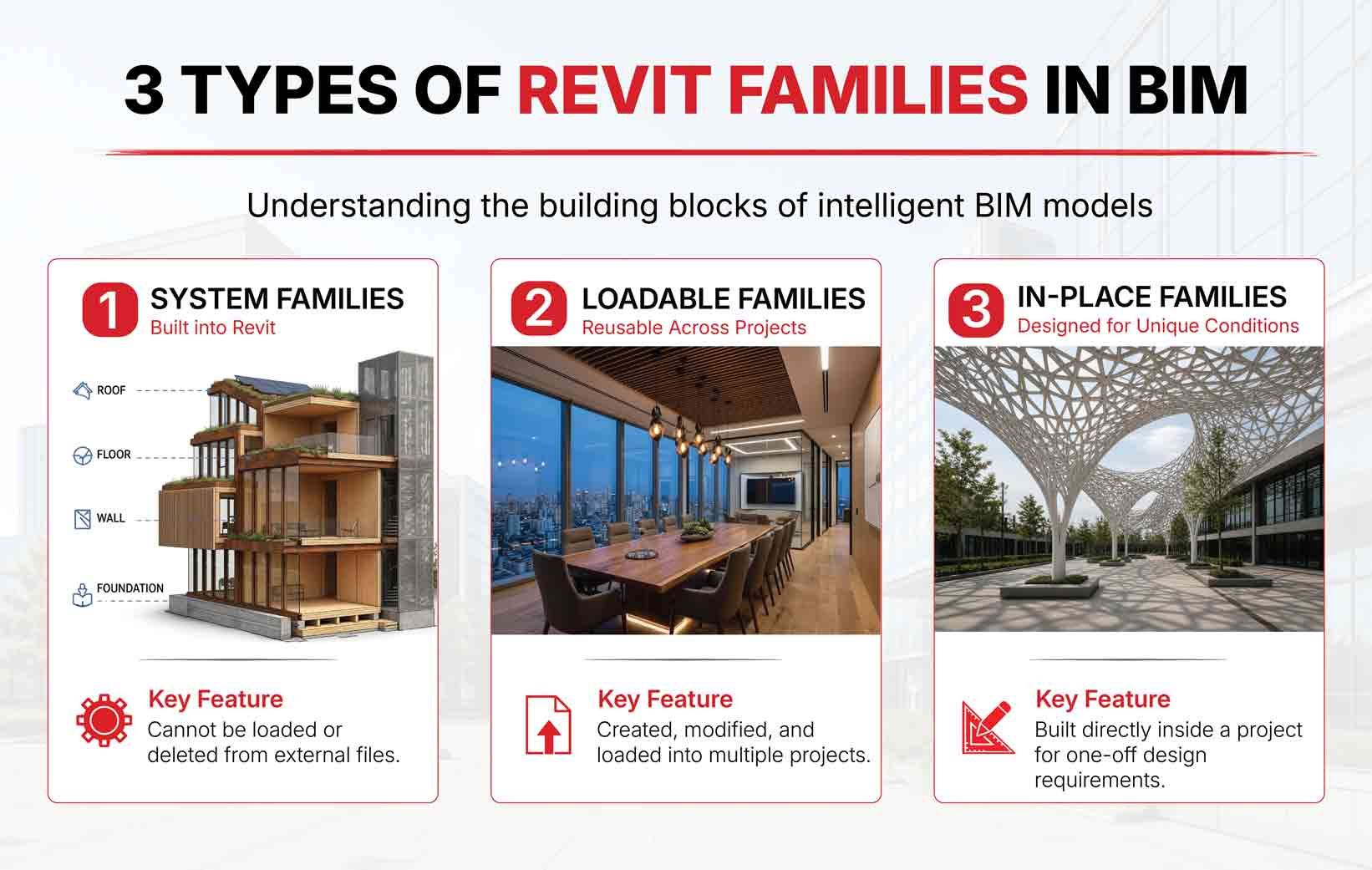
Revit includes three primary family types:
- System Families such as walls, roofs, and floors
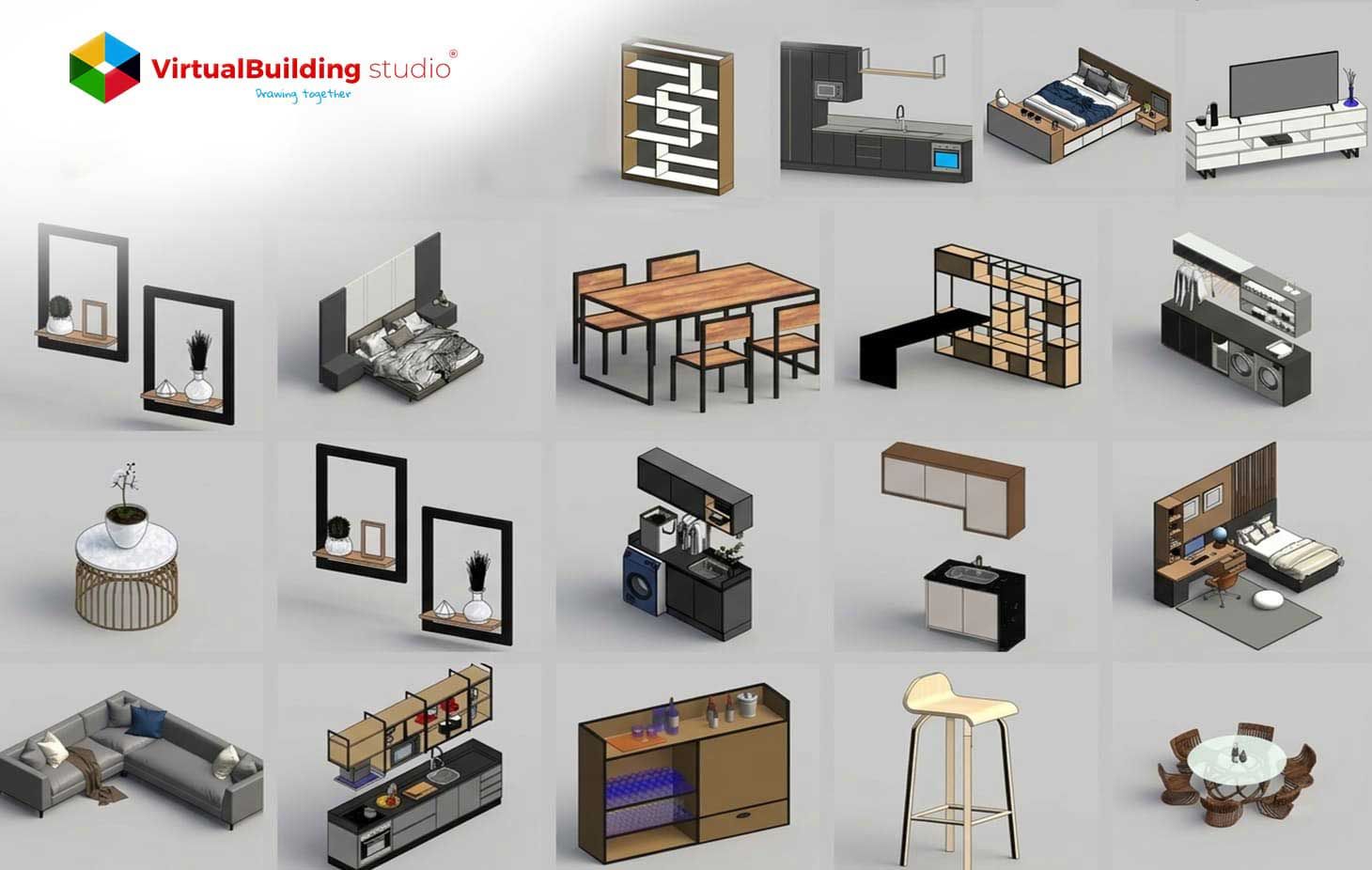
- Loadable Families such as doors, windows, furniture, and MEP equipment
- In-Place Families created for unique project conditions
Most Revit family creation services focus on loadable families because they support reusable BIM object libraries. Through intelligent BIM object creation and parametric BIM component development, these families become the foundation of efficient BIM workflows.
How Revit Families Improve BIM Workflow Efficiency
Once intelligent BIM objects become part of the model, teams can manage information more efficiently. This benefit extends throughout project delivery. Whenever a design change occurs, traditional CAD workflows require repeated updates across multiple drawings. As project complexity increases, maintaining consistency becomes more difficult.
Revit families reduce that challenge because geometry and information remain connected. When a user modifies a family parameter, related views, schedules, quantities, and documentation update automatically. This reduces manual coordination effort and improves accuracy.
Several workflow improvements result from this approach:
- Faster design revisions become possible.
- Quantity takeoffs from automated extraction.
- Project documentation remains consistent.
- Reduced need for repetitive modeling tasks.
- Information management improves across disciplines.
These benefits grow even greater when firms maintain standardized content libraries. Reusable BIM object libraries support BIM data standardization. Object-based modeling workflows help teams deliver projects more efficiently. Workflow efficiency naturally becomes connected to project coordination and collaboration activities as firms expand BIM adoption.
Role of Revit Families in Construction Coordination and Collaboration
With BIM workflows continuing to mature, greater emphasis on coordination is placed by project teams. Design efficiency creates value only when architects, engineers, contractors, and consultants can work from reliable information.
Accurate BIM coordination in architecture depends on quality-assured model content. Building components can contain incorrect dimensions, missing clearances or incomplete data. Coordination teams spend more time to validate model information before making decisions.
Revit families help in addressing this issue. They provide consistent geometry and standardized information across all disciplines. Architectural, structural, and MEP teams can reference the same coordinated content throughout project development.
This consistency plays an important role in BIM coordination services and multi-disciplinary project delivery. Accurate families support:
- Routing of systems becomes reliable.
- Constructability reviews: better outcomes.
- Quantity validation shows improvement.
- Consistent documentation across disciplines
- More effective design reviews
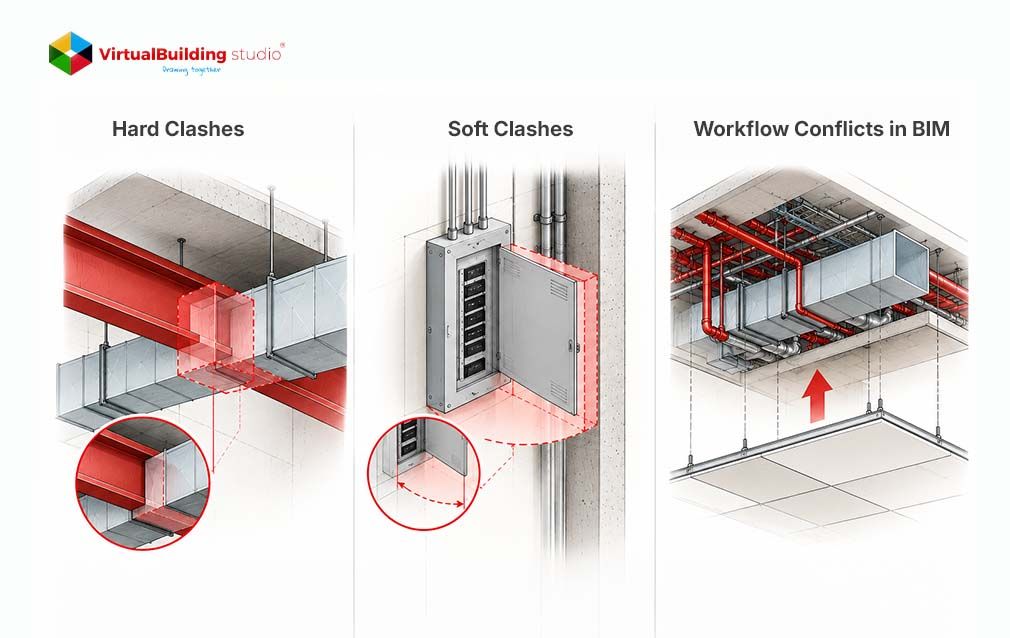
The impact becomes even more visible during BIM Clash Detection Services. Clash detection software evaluates the geometry contained within the model. Families do not accurately represent real-world conditions. Coordination teams receive data that is unreliable.
Well-developed families improve clash detection because they include:
- Accurate dimensions
- Correct connector locations
- Equipment clearances
- Maintenance access zones
- Appropriate LOD BIM modeling requirements
The quality of Revit families becomes a significant factor in project success as firms pursue BIM-driven construction coordination. Those coordination benefits explain why many AEC firms invest in Custom Revit Family Creation rather than relying solely on generic content.
Studies report that coordinated BIM workflows can reduce coordination-related RFIs by up to 40% and decrease downstream conflicts by approximately 30%.
Benefits of Custom Revit Family Creation for AEC Firms
The coordination advantages discussed above depend maximum on the quality of the model content to be used. Generic BIM libraries can support basic modeling activities. But many projects require information, geometry, and behaviors that standard content cannot provide. This is where custom Revit family creation delivers value for AEC firms.
Better Standardization in Every Project
Custom families follow consistent naming conventions. They also adhere to parameter structures and classification systems. This helps in standardizing BIM data. It helps project teams to maintain consistency across various projects.
Higher Productivity While Modeling
Designers spend less time in searching for content or recreating objects from scratch. Reusable BIM object libraries allow teams to focus more on design development and coordination activities.
Better Support for BIM Coordination
Custom families contain actual dimensions, clearances and connector information. This gives BIM coordination services more reliable content. The content supports coordination reviews and clash detection workflows.
Alignment with Client Requirements
Different clients require different formats of data. Custom families can include all such data, like asset information, manufacturer data and facility management attributes. These attributes support construction lifecycle BIM integration.
Improved Model Performance
Well-developed families contain only the geometry and information required for project delivery. This reduces unnecessary model weight. It improves overall project performance.
BIM Outsourcing Services Deliver Greater Value
Firms using BIM outsourcing services can maintain consistent standards among the multi-trade teams. They provide approved family libraries and modeling guidelines.
These benefits create a stronger foundation for coordinated multi-disciplinary BIM modelling services in the USA. Firms standardize content and improve model quality. They reduce many errors. These errors traditionally lead to RFIs, change orders, and field rework.
How Revit Families Reduce Errors, RFIs, and Rework
Reducing errors begins long before construction starts. Most coordination issues originate during design development when incomplete information, inconsistent documentation or unresolved clashes remain inside the model.
Research indicates that rework can account for 5 to 15 percent of total construction costs.
Maximum of those costs stem from issues that could have been identified earlier through coordinated BIM workflows. Accurate Revit families help in addressing this challenge. Using parametric Revit families, teams can improve the quality of project information used throughout design-build process.
Parametric controls reduce errors because changes occur throughout the project. Teams do not have to manually update multiple views after every revision.
This results in better information quality, fewer coordination gaps and more reliable constructability reviews. When project teams gain confidence in model accuracy, they can move beyond error reduction. They can then focus more on improving project delivery speed and quality.
Impact of Parametric Revit Families on Project Speed and Accuracy
Once project teams prepare reliable BIM content, the next step is improving project delivery speed without affecting quality. Parametric Revit families support both these goals. They allow teams to manage change in a better way.
Faster Design Changes
Design teams can change parameters instead of recreating the whole geometry. This speeds up design updates and option studies while providing greater consistency.
Automated Documentation
Plans, elevations, schedules, sections and other related data update automatically when family parameters change. Teams spend less time managing documentation updates.
More Accurate Quantity Takeoffs
Dimensions, materials and object properties remain connected to schedules. This improves reporting accuracy and reduces manual calculation effort.
Better Support for Analysis
Parametric BIM component development helps teams evaluate performance, cost, and operational requirements. They can use the same coordinated information source.
Optimized Design to Construction
Information created during design remains available for coordination, procurement, fabrication and FM activities.
Improved Coordination Accuracy
Accurate family behavior supports coordinated multidisciplinary BIM modeling by ensuring that all trades reference the same reliable project information.
These advantages help firms deliver projects more capably. The team must establish clear standards and governance processes to achieve this level of efficiency. This will ensure that family content remains reliable as projects and libraries grow.
Best Practices for Efficient Revit Family Creation in Construction Projects
The speed and accuracy benefits of parametric families can be realised depending on how those families are developed and managed.Advanced BIM workflows can lose efficiency if they contain inconsistent standards, unnecessary geometry, or poorly structured parameters.
Align Families with Project LOD Requirements
Families should be prepared following AIA-approved Level of Development Specification.This will help in avoiding introducing unnecessary complexity.
Establish Standardized Parameters
Consistent parameter structures support BIM data standardization. They improve reporting, scheduling and coordination.
Prioritize Reusable Content
Reusable BIM object libraries reduce repetitive modeling efforts. They help in maintaining consistency when simultaneously working on multiple projects.
Optimize Geometry for Performance
Families should contain the necessary information needed for coordination and documentation. They should not add unnecessary geometric data, as that can affect model performance.
Validate Content Prior to Deployment
Quality assurance reviews allow teams to validate family behavior, parameter operation and conformance to project standards prior to active implementation.
Standardize External Content
Audit external families used by manufacturers, CAD to BIM services providers, or Revit modeling services providers for compliance with internal standards.
Keep Library Governance
Clear ownership, approval process and revision controls help to effectively manage growing family libraries.
These practices help organizations maximize the value of intelligent BIM object creation. The family libraries support coordination, productivity, and long-term project delivery goals.
Conclusion
Efficient BIM workflows depend on accurate, reusable and standardized project information. Revit families provide the structure. Project teams use that structure to manage information consistently. The process spans design, coordination, documentation and construction.
Project teams create content through intelligent BIM object creation and parametric BIM component development. That content supports automation, collaboration and reliable decision-making. These capabilities improve coordination quality. They reduce errors. They strengthen design-to-construction digital workflows.
Projects are becoming increasingly complex. Firms need content that supports coordinated multi-disciplinary Revit modeling services and construction life cycle BIM integration. Content may be developed internally or through Revit family creation services. High-quality families remain a critical component of successful BIM implementation. They also support long-term workflow efficiency.

Boost BIM Efficiency with Scalable Revit Content Libraries