Architecture and engineering firms are stuck with an uncomfortable math problem right now. Billings have been sliding for months, backlogs are unpredictable, and firms still need to turn out the same volume of coordinated Revit models regardless of how thin the pipeline looks that quarter. Hiring licensed staff to absorb a temporary spike makes little sense when next quarter could look completely different.
This is the gap that outsourcing Revit modeling fills, and it's why more firms now treat it as a standing part of production strategy instead of a stopgap. The real question isn't whether to outsource. It's whether your firm understands what the arrangement actually involves before handing over the work.
What Is Revit Modeling Outsourcing?
Revit modeling outsourcing means handing model authoring, documentation, and information production tasks to a team outside your firm. Whereas your firm keeps the design decisions, the professional stamp, and the responsibility attached to both. That distinction matters more than most firms realize.
Treat it as a production arrangement, not a design arrangement. An outsourced team builds the model against standards your firm sets. Your licensed staff still directs the work, reviews it in progress, and signs off before anything moves forward.
International standards back this framing. ISO 19650 treats an outsourced team as a task team operating inside a structure where the client defines requirements, a lead party coordinates delivery, and task teams deliver against agreed plans. Before any Revit outsourcing services vendor gets involved, the standard requires the appointing firm to check that vendor's capability and capacity. That check isn't a formality. It's the due diligence step that decides whether the whole arrangement holds up.
Why AEC Firms Outsource Revit Modeling
That due diligence question exists because the economics behind outsourcing Revit modeling are hard to ignore. Deltek's Clarity industry study puts the median overhead rate for AE firms at 160% of direct labor, with utilization sitting around 61%. That means every dollar spent on a modeler's salary needs to generate roughly $2.60 before the firm earns anything, and more than a third of paid staff time never reaches a billable project at all. Shifting production hours from salaried headcount to a project-charged service eases that arithmetic directly.
Demand isn't cooperating either. The AIA Architecture Billings Index has stayed below 50 for months straight, meaning billings keep contracting while average backlog still runs above six months. Firms can't justify hiring permanent staff for work that might vanish next quarter.
Labor supply isn't growing fast enough to fix this from the inside. BLS projects drafting employment growing only about 5.2% over the next decade, nowhere near enough to absorb a real demand spike. Regulation adds more pressure on top. Firms bidding internationally need more standards-compliant model output than an internal team alone can usually produce.
What Revit Modeling Services AEC Firms Can Outsource
That growing volume of required output raises an obvious question: which parts of the work actually make sense to hand off? Not every Revit task is suited to outsourcing. The tasks that work best are governed by a written standard, something an outside team can be measured against objectively. Where judgment or final engineering decisions are involved, that work stays in-house.
Here's how that plays out in practice:
- Revit architectural BIM modeling services cover walls, floors, roofs, curtain systems, and sheet sets. Once a template and LOD table are locked, this work is highly delegable.
- Revit structural BIM modeling services handle framing, foundations, and connections up to LOD 350, with rebar detailing at LOD 400. Modeling delegates easily; final design decisions stay with the licensed engineer.
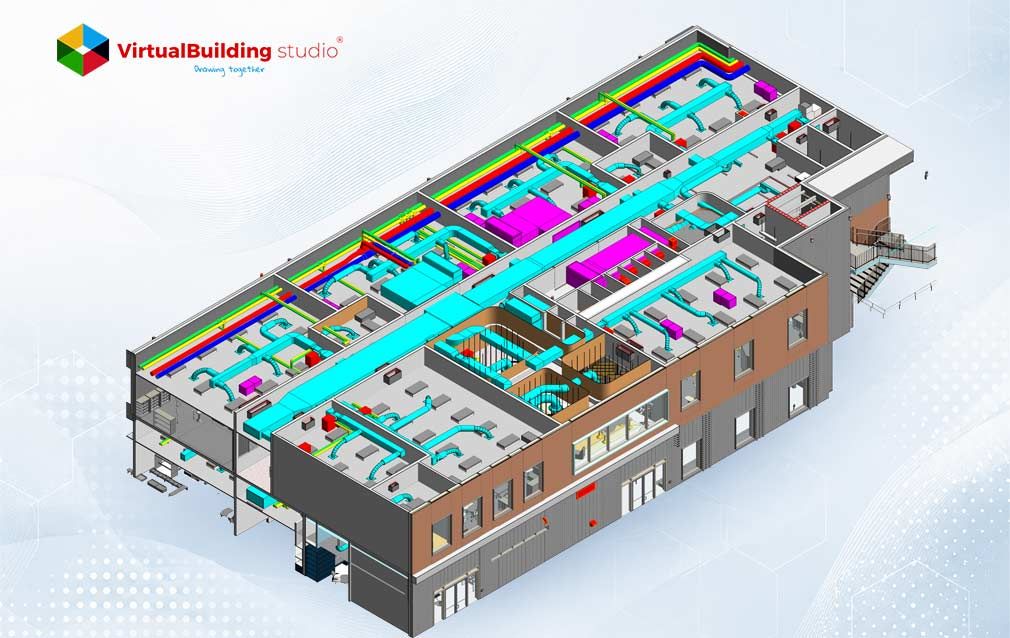
- MEP modeling and coordination covers ducts, pipes, and clearance zones. Modeling can move offsite, but clash resolution still needs an engineer's direction.
- Revit family creation service is the most standard-driven work on this list. Parametric objects carrying IFC and COBie property sets can be built entirely against a written spec, which makes family libraries a low-risk starting point for firms testing outsourcing for the first time.
- Scan to BIM, model auditing, and shop drawing production round out the list, each with pass-fail criteria a vendor can be held to.
Knowing which tasks to hand off is only half the equation. The real payoff shows up once that delegated work starts moving through a properly resourced pipeline, and that's where the actual gains become measurable.
Benefits of Outsourcing Revit Modeling
Once a firm knows what to hand off, the upside shows up in more than the invoice. When a team has enough hands-on deck, coordination actually happens during design instead of getting pushed to the field.
Peer-reviewed research on BIM-based clash detection backs this up. One study found early clash detection cut design errors by more than 70% and saved close to 30% of project time on MEP-heavy work. Added capacity helps, but it isn't a guarantee by itself. One long-running study found that measuring rework without changing process discipline didn't produce lasting improvement over six years.
Beyond the numbers, outsourcing changes how a firm operates day to day:
- Production shifts from a fixed salary cost to a variable, project-charged expense.
- Time-zone gaps let overnight production hand-offs happen through a properly managed data environment.
- Vendors working across multiple markets often know international BIM standards better than a single-market firm does.
- Licensed staff get freed up for the coordination and review work only they can legally sign off on.
These gains don't happen by accident, though. They depend on a structured process that keeps quality and accountability intact from day one. That process is what separates firms that see real returns from those that just move problems offshore.
Revit Outsourcing Workflow: Step by Step
Getting these benefits consistently depends on following a clear process, not improvising one. ISO 19650's information delivery cycle offers a ready-made structure that maps directly onto a vendor relationship built for outsourcing Revit modeling.
Assessment first, vendor second
Before contacting anyone, the firm needs its Revit template, shared parameters, naming convention, and Level of development (LOD) table locked down. Skipping this step is the single biggest reason engagements fail, because there's no objective basis for accepting or rejecting delivered work.
Tender and capability check
This is where the firm formally assesses whether a vendor has the bench strength and standards fluency the scope demands.
Appointment and planning
Both sides confirm the BIM Execution Plan, build a responsibility matrix, and sign the contracts that matter, including an information protocol and an explicit copyright assignment.
Mobilisation and pilot
Run a small, representative piece of work through the full process before committing to volume. Revit version alignment gets locked here too, since an upgraded file can't be reopened in an older release.
Collaborative production
Work moves through defined states, from draft to shared to published, with sign-off at each transition. Scheduled review gates during this phase keep licensed staff genuinely involved, not just present at handoff.
Delivery and close-out
Models get authorized, accepted, and archived, and the firm updates its own standards library with anything the engagement revealed.
Following this workflow protects quality and keeps responsible control intact at every stage. But none of that answers the question every finance lead eventually asks: what should this actually cost, and how do you know if a quote is fair.
Revit Outsourcing Cost: What Should AEC Firms Expect?
Following that workflow properly also shapes what a fair price looks like. No credible source publishes standard rates for outsourcing Revit modeling, and any vendor quoting a fixed number without context deserves a follow-up question. What's available is a baseline to measure against.
BLS wage data puts the median drafter salary at just over $66,000 a year, or roughly $31.80 an hour. Layer a typical overhead rate on top, and the fully loaded internal cost climbs past $80 an hour before profit even enters the picture, and that's before accounting for the fact that only around 61% of paid hours reach a project at all.
A few factors legitimately move the price beyond that baseline:
- Level of Development is the biggest lever. LOD 300 is the standard commercial deliverable; LOD 350 and 400 cost more because they add coordination detail and fabrication-ready data.
- Information content matters as much as geometry. A family built to full COBie and IFC specification costs more than a geometrically identical one without that data, and pricing on geometry alone while expecting compliance later is a common source of disputes.
- Delivery location wage structure explains much of the spread between vendor quotes, and that gap is expected to hold for decades rather than close quickly.
- The retained cost of in-house review belongs in the calculation too. Responsible control can't be delegated, so budgeting for a licensed reviewer's time is part of the real cost, not an afterthought.
Understanding these cost drivers puts a firm in a strong position to evaluate quotes. What it doesn't do is guarantee the vendor behind that quote can actually deliver against the standards and security expectations the engagement demands.
How to Choose the Right Revit Outsourcing Partner
Once the cost picture is clear, selecting the right Revit outsourcing company becomes the deciding factor in whether that cost turns into value. Treat selection as the same capability-and-capacity check ISO 19650 requires before any tender gets awarded.
- Standards fluency, proven rather than claimed
Ask the vendor to complete a Model Element Table or an information protocol form for a live project without coaching. If they can't, they aren't operating as a real task team.
- Contractual readiness
Confirm the vendor will sign an actual copyright assignment, not just a work-for-hire clause, since architectural drawings don't automatically transfer ownership through that language alone.
- Security posture
Construction now ranks among the most targeted sectors for ransomware, and average incident downtime runs close to a month against a tolerance window most firms can't survive. Ask about access controls and third-party data agreements directly.
- Version discipline
Since Revit files can't be downgraded once opened in a newer release, confirm the vendor works on the exact release your project needs.
- Real capacity, not average capacity
Ask for named individuals with stated Revit release experience, not a general claim about bench strength.
A partner that resolves your software, training, and expertise gaps earns the fee. One that leaves your team confused about who owns which decision doesn't.
AI and Automation in Revit Outsourcing
The vendors that pass those checks today are also investing fastest in automation, since it changes which parts of outsourcing Revit modeling are worth paying a human for. Outsourcing partners adopt these tools first because they run the same task at a scale no single firm can match.
- Cloud-based tools run headless Revit to generate families, extract data, and produce documentation without a desktop license.
- Script-driven tools like Dynamo let a vendor build a workflow once and hand it to a firm's team to reuse.
- Research on deep learning methods for segmentation of point clouds says Scan to BIM models now reach around 86% average segmentation accuracy, with door detection topping 96% for the best tools. Windows and small elements remain weak, and researchers note current models aren't yet accurate enough for unsupervised adoption.
Automation compresses the repetitive middle of production while leaving both ends untouched. Final decisions and verification still need a human, since no licensing body accepts a script as the party in responsible charge.
Conclusion
Outsourcing Revit modeling works best when a firm treats it as a governance decision, not a shopping decision. The economics are sound. High overhead rates, thin utilization, and a labor market that isn't growing fast enough all point the same direction. But the firms that actually benefit are the ones that do the groundwork first: a defined information standard, a genuine capability check on the vendor, a signed copyright assignment, a security review, and review gates that keep licensed staff in real control of the work.
Skip that groundwork, and outsourcing doesn't solve the capacity problem. It just relocates it somewhere harder to fix, across a contract line instead of inside your own office. Build the framework properly, and outsourced Revit capacity starts behaving like an extension of your own team rather than a separate risk to manage.
Ready to scale your Revit production without the overhead?