+1 (409) 800-6601
 contact@virtualbuildingstudio.com

Most clients can’t read drawings. The architect can see a completed building in plans and elevations. The client sees lines on a piece of paper. That gap costs owners time and money in the form of late approvals, designchanges, and hard-to-sell units.
3D architectural visualization Companies close that gap with images, films, and walkthroughs that anyone can read in seconds. Dozens of US companies promise photorealism, though, and their portfolios look the same. There are five studios that consistently rank high in quality, and would make a good benchmark for any shortlist.
What Is 3D Architectural Visualization?
Before the advent of 3D architectural visualization, architects struggled to show clients buildings that didn't exist in the real world. For centuries they relied on hand drawn perspectives and physical models. They worked but they took weeks and gave only one fixed view.
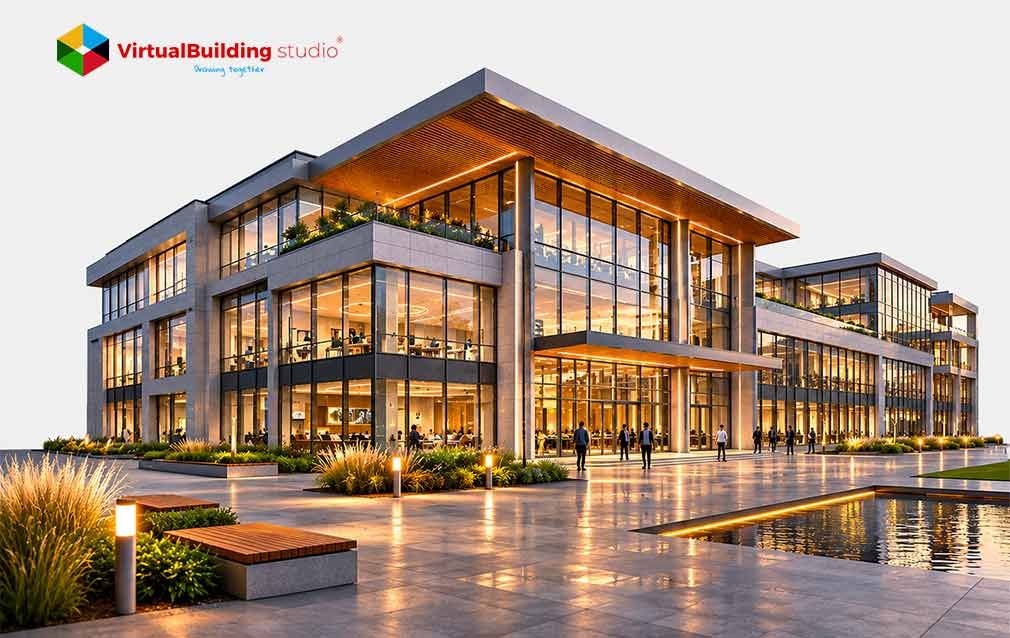
3D architectural visualization replaces that process by generating images from a digital model. The artist takes the model from the architect, adds material, light, furniture, and people. Then they convert the scene to a photo of the building.
Different people use it for different jobs:
- Architects use it to try design ideas and show plans to clients.
- Developers use it to advertise and sell units before construction begins.
- Planning board utilizes it to compare whether a project fits the surrounding streetscape.
- Owners and contractors use it to avoid expensive changes later.
The teams use the image to speed up decisions and eliminate unforeseen events on site.
How We Selected the Top 5 Companies
Judging who does visualization well gets harder each year because the market keeps growing. Grand View Research valued the global architectural and interior design 3D rendering market at US$1.9 billion in 2025. The firm expects 19.2% yearly growth through 2033, with North America as the largest market.
We applied 4 filters to identify the top 3D architectural visualization companies for US projects:
- US market focus: The studio specifically targets US architects, builders, and developers.
- Range: Stills + animation, tours, or VR from one team.
- Clear process: Pricing, delivery times, or defined scope of service are published.
- Real Work: A public portfolio with named clients/projects.
Five studios cleared every filter.
Virtual Building Studio (Houston, Texas)
Virtual Building Studio stands out on this list because of its size and its strong connection to the Architecture industry. The Houston-based company has more than 11 years of experience in the field and has finished over 4,000 projects. The team at Virtual Building Studio includes 400+ US-trained architects and engineers.
- Offers exterior and interior renders, walkthroughs, flythroughs, and 360° tours.
- Features BIM-based visualization with Revit and Navisworks in its toolset.
- Works in 3Ds Max, V-Ray, Lumion, and Unreal Engine. VR and AR ready files.
Best for: Architecture and construction firms that want visuals associated with their BIM models.
Maverick Frame Studio (London, United Kingdom)
Maverick Frame Studio combines product CGI and architecture to create the range filter. The company was started in 2016 and operates from its London office. The team that has between 50 and 249 people works with architects, developers, and interior designers.
- 3D animation, exterior views and interior views and 360° panoramas.
- Creates product visualization as well as AR and VR experiences.
- Shares a price list so buyers can plan their budget before asking for a quote.
Best for: Brands and developers who want architecture and product visuals, from one studio.
ArchiCGI (San Francisco, California)
ArchiCGI is the best fit for the clear process filter. "It publishes a full price list, spelling out what each price includes."
- Provides standard still renders within 48 hours of receiving prepayment and a complete project brief.
- Includes a 100,000+ 3D model library of furniture, plants, people, and cars.
- Includes exterior and interior renders, 360° tours, animation and 3D floor plans.
Best for: Architects and builders who need fixed quotes and quick turnaround.
Render Art Studio (Warsaw, Poland)
Render Art Studio is an example of how a remote team can serve US cities. Founded by Malgo Widaj, it has been running since 2017. The studio has dedicated service pages for New York, Houston, Miami, Los Angeles and San Francisco.
- Its clients include Foster + Partners, Sweco, and Google Campus.
- Creates competition imagery, investor CGI, and pre-sales imagery.
- Also offers stills, animations, and virtual tours.
Best for: Competition entries and investor presentations.
BASE3D (California and New York)
BASE3D continues to focus its offering on stills and motion. It lists California and New York studio lines and services projects throughout the U.S.
- Works for architects, developers and interior designers making every concept come alive.
- Produces exterior stills and architectural animations turning rooms into stories.
- Has a portfolio of hospitality workplace work, showing a wide range of projects.
Best for: Interior-led projects needing stills and short films delivering a professional touch.
Each of these studios has a combination of services and that combination decides which studio fits your project.
Types of 3D Architectural Visualization Services
The five studios above lead with different strengths, but they draw from a shared menu. Most architectural visualization services fall into six types:
- Exterior renderings: Still images of the building in context, for approvals and marketing.
- Interior renderings: Rooms with finishes, furniture, and lighting. Used to sell units and confirm design choices.
- Aerial views: Bird’s eye pictures that show the site, the mass of the building, and the neighborhood.
- Flythroughs and animations: They are quick flicks that move the camera throughout the structure.
- 360° virtual tours: Panoramas that allow customers to use a phone or headset to view a room.
- VR and interactive experiences: 3D living models that let the user move around a room and alter the finish.
A still image can show how a lobby looks. Whereas a video or virtual tour can demonstrate how it feels to move through the space. Most customers start with static pictures and add the option of motion or interactive content once they have the budget. Virtual tours or VR enable potential clients to examine the location themselves.
Producing these formats takes more than talent, and that brings us to the tools.
Technologies Used by Leading Visualization Companies
Every format in the last section depends on software, and that software has changed fast in the past decade. Leading studios now work with four groups of tools:
- The building can be designed or imported using 3D modeling tools such as Autodesk 3ds Max, Revit and SketchUp.
- Artists can use rendering engines like Chaos V-Ray and Corona to make movies and photorealistic still images.
- The Real-time Engine, Twinmotion, and Enscape allow for live scene exploration and VR tour creation.
- Graphics cards from NVIDIA let artists preview realistic lighting in seconds instead of hours.
AI tools are the newest addition to that kit. Studios that market themselves as AI architectural visualization companies use image generators to test moods and materials during early design. Architects remain cautious. An AIA study found that just 6% of architects use AI regularly while 53% are experimenting with it.
AI helps studios get faster on concepts, but good final images still require talented artists. Both speed and skill show up in the price, which is the next question every buyer asks.
How Much Does 3D Architectural Visualization Cost in the USA?
Pricing follows the same logic as the tools: simple scenes cost less, and custom work costs more. Most US studios price stills per image, films per second, and tours per project. ArchiCGI, from the list above, publishes these starting prices in its 2026 rendering cost guide:
These figures are floors, not averages. Studios quote larger packages, such as a full pre-sales campaign, per project.
Any quote moves up or down according to three factors:
- Input quality: It costs less to render a clean 3D model than a set of PDF drawings.
- Scope: Each additional view, second of film or piece of custom furniture adds hours.
- Revisions: Rounds beyond the ones covered in the quote are billed separately with revisions.
These figures are useful for comparing quotes, but price alone won’t find you the right partner.
How to Choose the Best 3D Architectural Visualization Company
Price is only part of the equation, say buyers. The bigger question is whether the studio is the right fit for your project. The best 3D architectural visualization companies for your project are the ones that best suit your goals in terms of strengths. Ask the candidates the following questions:
- What is the picture for? Planning approvals are about accuracy; pre-sales campaigns are about emotion and polish.
- Have you done buildings like yours? Request three comparable projects, not their top reel.
- What files do they accept? If a studio is working off Revit, SketchUp or CAD files that saves you money on modeling.
- How many revisions are included? Write out the number before you sign.
- Can they scale the project? A studio that does still, film, and VR means you don’t have to change vendors mid-campaign.
One small paid pilot answers most of these questions in one go. Get one exterior photo before signing up for a full package. That one image shows you how fast they are, how they communicate, and how much attention to detail they have.
Big name isn’t always needed for small projects. 3D architectural rendering services providers are focused and can deliver strong stills for permits and listings at lower budgets. The specialist team’s Architectural 3D visualization is ideal for projects where clarity trumps branding.
To choose well today is also to think about where the industry is headed next.
The Future of 3D Architectural Visualization in 2026
The questions will continue to change because the tools used for visualization are changing.Three shifts stand out this year:
- Real-time work is spreading. VBS, Maverick Frame Studio, and ArchiCGI already offer VR, AR, or 360° work alongside stills.
- AI is speeding up concept work. Artists test materials and lighting moods in minutes, then refine the chosen option by hand.
- Interactive sales tools are on the rise. Sales galleries use touchscreen apps and VR tours for buyers to pick finishes.
The best results for studios utilizing AI in architectural visualization come when it is used as an assistant. Even specialized AI architectural visualization companies still need artists for the final accuracy.
The best 3D architectural visualization companies to work with in 2026 mix tools with traditional skills.
Conclusion
Clients still have trouble reading drawings. That problem isn’t going away by 2026. The five studios here are each finding their way using different mixes of size, speed and expertise.
You need to make that mix work for you. Begin by knowing what you want from the visuals. Then run a pilot at a studio you’re interested, in. Check the prices of 3D architectural rendering companies for the task. Teams that follow these steps get visuals that win approvals and sell projects before ground breaks.

A great design loses value when clients can’t see it. Make every drawing impossible to misread.