+1 (409) 800-6601
 contact@virtualbuildingstudio.com

AEC teams now work in a world where clients expect coordinated models, reliable quantities, and project information that remains useful after design and construction. That pressure affects the quality of the content inside the model, not just the visual accuracy of the model itself. Revit family creation services play a major role in meeting those expectations. In a BIM workflow, families store geometry, parameters, metadata, visibility settings, and behavior rules. Every schedule, section, tag, and coordination view depends on that information. Weak or inconsistent family content can create inaccurate quantities, unreliable documentation, coordination conflicts, and repeated manual corrections across the project lifecycle.
Research on construction data quality also shows that poor project data and miscommunication were responsible for 48% of rework in U.S. construction.
The Role of Revit Family Creation in Modern AEC Industry
The reason BIM object creation services matter so much is the model quality that drives project reliability. BIM value studies consistently connect better content with lower rework, more reliable quantities, stronger coordination, and better schedule performance.
Revit families belong to the center of how design intent becomes usable project data. A family is not just a shape in a model. It is a template-driven definition that tells Revit how an object behaves, connects, schedules, and displays across views. Autodesk guidance treats custom family creation as a core Revit skill. When firms use BIM content creation services well, they standardize how doors, equipment, fixtures, and other components behave across projects and disciplines.
That role matters because modern delivery has moved beyond drawings alone. A single BIM model now supports coordination, quantity takeoff, documentation, analysis, and lifecycle handover. The same family can influence multiple outcomes at once. If a wall family carries the wrong layer structure or an equipment family misses key parameters, the problem spreads into schedules, cost reports, and coordination views. Revit BIM modeling services now depend on content governance as much as geometry creation.
What Is Revit Family Creation?
Revit family creation is the process of building reusable BIM objects in a parametric way so they can flex across sizes, types, and project conditions. In practice, this work focuses mainly on loadable families such as doors, windows, furniture, MEP equipment, lighting, and symbols. Those are the reusable items that make BIM object libraries useful. The process begins with a clear use case. It then moves through reference planes, parameter strategy, visibility control, and testing.
That structure matters because a parametric Revit family behaves like a controlled system. Teams define the skeleton first. They attach geometry to parameters. They decide what should be type-based and what should be instance-based. The Revit experts then test the family under different conditions. The Revit family creation process is a data design process with geometry attached to it. BIM content creation services are often brought in when internal teams need dependable output at scale.
Why Revit Family Creation Is Critical for AEC Firms
The reason BIM object creation services matter so much is the model quality that drives project reliability. BIM value studies consistently connect better content with lower rework, more reliable quantities, stronger coordination, and better schedule performance.
Autodesk’s construction statistics summarize rework as roughly 5% to 9% of total project cost, depending on the study.
That is why parametric object-based modeling in Revit becomes a business issue, not just a design-built process preference. A poorly structured family can distort quantities, confuse schedules, weaken clash detection, and force manual correction later in the project. A well-built custom Revit family does the opposite. It keeps geometry, data, and behavior aligned from the start. For firms trying to outsource Revit family creation, the goal is not only to save time. It is to reduce the error chain that starts inside the content library and ends onsite.
How Revit Families Improve BIM Workflows
When families are built correctly, they make the entire workflow more predictable. They reduce friction at the point where design intent becomes project information. That helps every downstream team.
- Speed Up Design Iteration: Designers can adjust dimensions and configurations through parameters instead of redrawing objects, which makes option studies faster and more controlled.
- Keep Documentation Tied to One Model: Families control plan symbols, sections, elevations, tags, and schedules, so sheets stay connected to the same data source.
- Coordination with Fewer False Conflicts: Accurate connectors, offsets, and clearances make clash detection more meaningful because the clash reflects an actual constructability issue.
- Help with lifecycle thinking: Families can carry asset IDs, maintenance data, and product links, which support digital twin readiness through Revit families.
That is also where BIM data structuring for AEC workflows becomes visible in daily work. A family library that follows shared naming, parameter rules, and view settings gives teams a consistent way to move from design to documentation without reworking the same content over and over
Benefits of Custom Revit Family Creation Services
Custom content matters because generic libraries rarely match a firm’s repeatable work. A practice may need a specific door clearance behavior, a standard casework module, or a façade panel that reflects its own detailing rules. Custom Revit family creation gives the firm a way to encode that pattern once and reuse it across many jobs.
- Firm Standards Stay Built into The Model: Teams do not need to redecide basic details every time they place an object.
- Content Hunting Drops Sharply: A central BIM library reduces the time spent searching online, patching legacy files, or rebuilding the same element from scratch.
- Models Stay Lighter and Faster: Good BIM object creation services keep geometry lean, avoid deep nesting, and use multiple LOD variants only when needed.
- Data Becomes Easier to Reuse: Clean parameter sets support tagging, scheduling, and IFC-friendly classification more reliably.
That is the practical value of BIM content creation services. They do not just make objects; they shape a reusable content system that lets teams move faster without losing control of quality. For many firms, that becomes the point where outsourced Revit family creation starts making operational sense.
Role of Revit Families in Construction Accuracy
Construction accuracy depends heavily on the quality of the BIM content inside the model. When families contain incorrect dimensions, missing parameters, or weak connection logic, those issues spread into coordination, quantity takeoffs, and construction documentation. That is why Revit family data optimization plays such an important role in project delivery.
- Improves Quantity Accuracy: Revit families control the material and dimensional data used in quantity takeoffs. Accurate family parameters help estimators produce more reliable cost calculations and procurement forecasts.
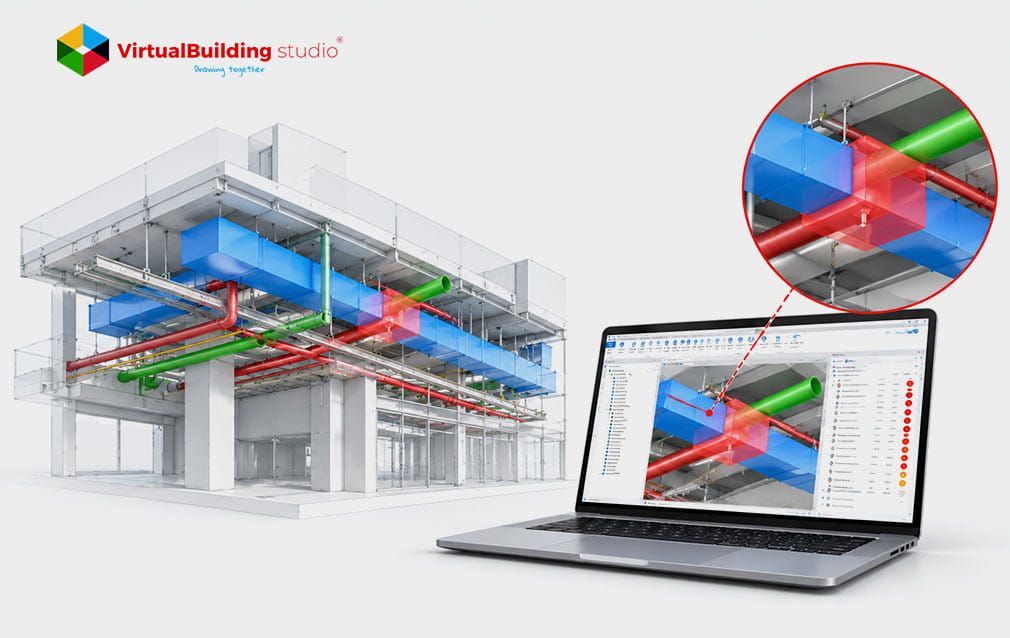
- Supports Better Clash Detection: Coordination workflows depend on accurate geometry and connection points. Correctly built families help teams identify real constructability conflicts before site work begins.
- Strengthens Fabrication Workflows: LOD Revit families support prefabrication because they include fabrication-level dimensions, tolerances, and assembly information. This helps fabrication teams prepare more dependable shop drawings.
- Reduces Documentation Errors: Families influence schedules, tags, sections, and detail views. Consistent family behavior helps teams generate coordinated construction documents with fewer manual corrections.
- Improves Site Coordination: Hospitals, airports, and data centers contain dense service zones and complex systems. Accurate families help project teams coordinate installations more effectively in these high-risk areas.
Strong family creation standards help firms maintain dependable, coordinated BIM model development across design and construction workflows. As BIM workflows become more data-driven, the quality of Revit families will continue shaping project accuracy from early design through final handover.
Outsourcing Revit Family Creation: Why Firms Prefer It
Many AEC firms reach a point where project delivery starts competing with internal content development. BIM coordinators, architects, and engineers need dependable Revit content, but family creation requires dedicated time and technical expertise. As projects become more data-driven, firms also need stronger parameter standards, cleaner geometry, and better QA processes across their libraries.
That pressure explains why many firms choose to outsource Revit family creation workflows instead of handling everything internally.
- Reduces Internal Bottlenecks: Family creation work usually falls on a small group of experienced Revit users. Outsourcing helps firms avoid overloading key team members with content development tasks.
- Improves Content Consistency: Specialized BIM content creation services follow structured workflows for parameters, naming standards, visibility settings, and QA testing. This helps firms maintain more reliable libraries across projects.
- Supports Faster Library Expansion: Firms can develop discipline-specific or client-specific content packages without building large in-house content teams. This becomes especially useful for healthcare, aviation, and data center projects.
Project teams also benefit because they can stay focused on coordination and design delivery instead of spending hours inside the Family Editor. That separation improves workflow efficiency across active projects.
- Provides Technical Expertise: Advanced parametric object-based modeling in Revit requires experience with formulas, constraints, hosting behavior, and performance optimization. External specialists bring focused expertise in these areas.
- Supports Long-Term Content Governance: Revit family creation services can help firms maintain version control, review workflows, and library standards over time. This creates more stable, coordinated BIM model development across multiple offices and project teams.
In practice, that is what makes outsourcing Revit family creation services feel less like a cost saving and more like a capacity strategy.
Industry Standards for Revit Family Development
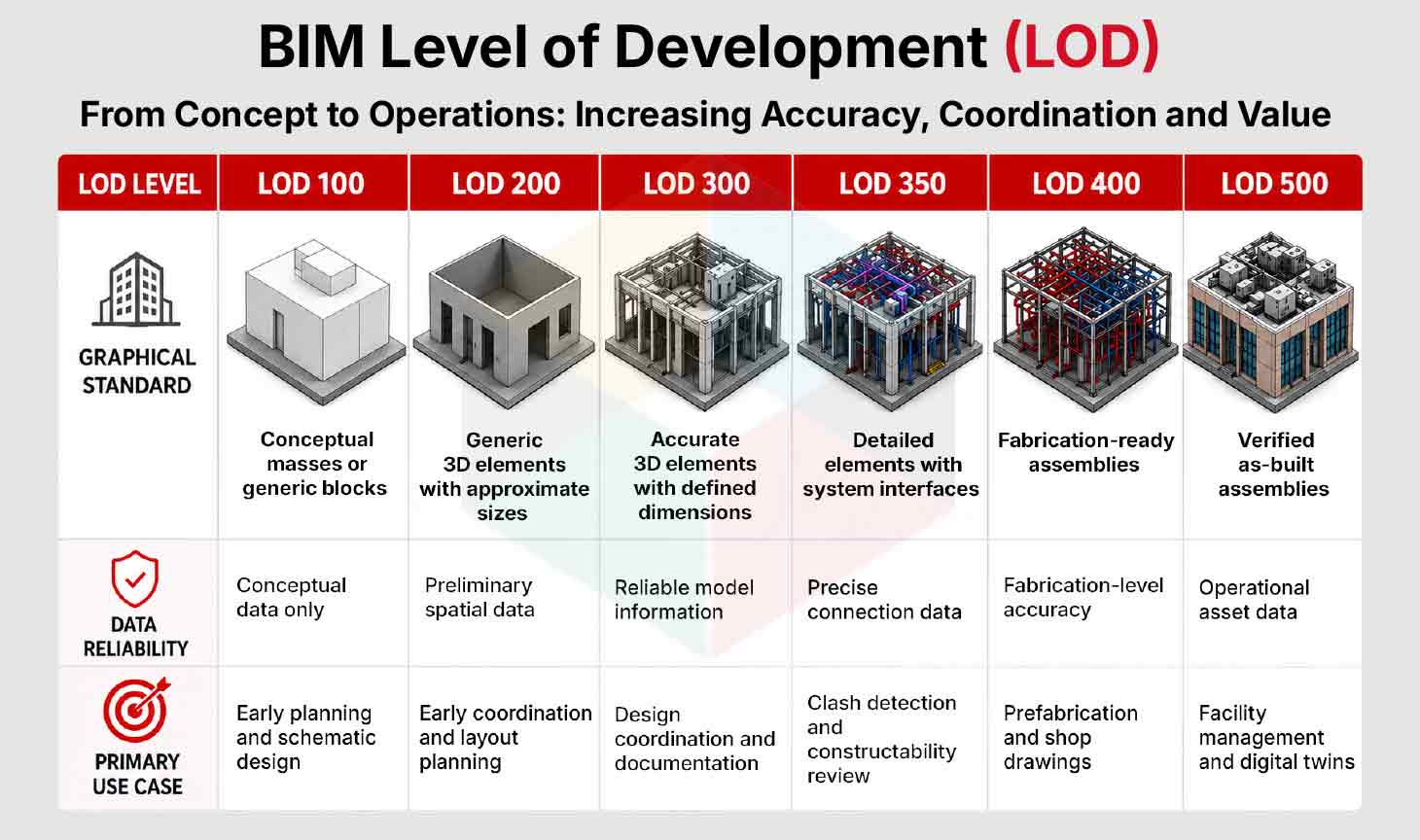
Standards give families a common language, which matters once projects involve multiple teams or multiple offices. The BIMForum LOD Specification remains one of the most widely referenced standards for defining BIM element reliability. The framework defines different Levels of Development ranging from conceptual content to fabrication-ready information. Those standards influence how teams structure geometry, parameters, and data inside families.
LOD standards also help firms avoid over-modeling. Higher LOD does not always require highly detailed geometry. In many cases, simplified geometry combined with strong information structures produces better workflow performance.
Parameter consistency also matters. Organizations such as NBS recommend standardized naming conventions, classification systems, and shared parameters. These standards improve interoperability across schedules, specifications, and IFC exports.
Strong governance practices help maintain library quality over time. Firms that manage approvals, version control, and content reviews usually maintain more dependable BIM libraries.
Common Challenges in Revit Family Creation
Family creation introduces several technical and workflow challenges. Most of these problems appear when firms build content without standards or structured review processes.
Over-modeling remains one of the most common problems. Excessive detail, deep nesting, and unnecessary formulas increase file size without improving coordination quality. Parameter inconsistency creates another major issue. Different naming styles and missing shared parameters make schedules and filters difficult to manage.
Many firms also struggle with fragmented ownership. Family creation happens under project pressure instead of through controlled library management. As a result, libraries accumulate duplicate or unstable content over time.
Future of BIM and Revit Family Creation in AEC Industry
BIM workflows continue moving toward connected data ecosystems. Models now support operations, maintenance, analytics, and digital twin environments in addition to design coordination. That shift increases the importance of structured family data. Future workflows will depend more heavily on asset identifiers, lifecycle information, and connected databases.
Parametric object-based modeling in Revit will also support more AI-driven workflows. Structured family data can help teams generate datasets for automation, simulation, and predictive analysis. This change will increase demand for Revit family data optimization and stronger content governance. Firms will need libraries that remain stable across multiple project phases and software environments.
BIM object creation services will likely become more specialized as standards evolve across architecture, infrastructure, MEP, and prefabrication workflows.
Conclusion
Revit families are much more than technical modeling components. They shape how BIM workflows perform across coordination, scheduling, documentation, fabrication, and lifecycle management.
That is why Revit family creation services now play such an important role in modern AEC delivery. Strong families help firms maintain cleaner data, more accurate coordination, and more dependable project outcomes.
BIM content creation services also help firms build reusable standards instead of repeating the same modeling work across projects. Firms that treat BIM content as long-term infrastructure can gain stronger consistency, better workflow performance, and fewer downstream corrections.

Transform Your BIM Workflow with Custom Revit Families.