MEP handover problems usually begin long before project closeout. During construction, different teams manage drawings, warranties, commissioning reports, and equipment records separately. Mechanical contractors maintain one version of information, electrical subcontractors maintain another, and field revisions continue changing layouts until the final stages of the project.
Those gaps become visible during handover. Teams rush to update redline drawings, collect O&M manuals, verify asset schedules, and respond to facility management requests simultaneously. As a result, owners often receive incomplete documentation, inconsistent as-builts, and disconnected asset data that create operational issues after occupancy.
The challenge becomes bigger on projects with complex building services such as hospitals, commercial towers, industrial facilities, and mixed-use developments. Facility teams then spend months rebuilding missing information before they can manage systems confidently.
This is where MEP clash detection services and BIM-driven workflows improve the process. Instead of treating handover as a last-minute documentation task, BIM connects geometry, asset information, maintenance records, and project data throughout design and construction.
In this blog, you will understand how BIM simplifies MEP handover, improves documentation accuracy, supports facility management, and helps project teams deliver usable operational data instead of disconnected files.
Challenges in Traditional MEP Handover
To appreciate what BIM-based handover offers, you first have to understand what traditional handover consistently fails to deliver. The root cause across all three failure patterns is the same: construction treats information as administrative overhead rather than as a product with its own quality requirements.
Missing and Disorganized Documentation
Construction projects generate huge volumes of information during execution. Teams manage commissioning reports, warranties, approvals, O&M manuals, and equipment schedules across multiple platforms and stakeholders. That scattered workflow creates major closeout issues later.
Common problems include:
- Missing commissioning records
- Incomplete warranty documents
- Untracked drawing revisions
- Disconnected equipment schedules
As a result, owners receive incomplete handover packages that require additional verification before operations begin.
Inconsistency in As-Built Documentation
Traditional as-built drawings usually depend on manual redline updates completed near project closeout. That process becomes unreliable once field conditions start changing MEP layouts during construction.
Typical site changes include:
- Rerouted ductwork
- Shifted pipe elevations
- Relocated conduits
- Modified access clearances
Many of these revisions never return to the final drawing set. As a result, facility teams receive inaccurate records where routing layouts and equipment locations differ from actual installations. Before renovation or maintenance work begins, owners often need another site survey.
Poor Asset Data and the Lack of Digital Intelligence
Traditional handover packages usually store asset information across disconnected spreadsheets, PDFs, and equipment manuals. Facility teams then spend unnecessary time searching for operational data instead of managing systems efficiently.
Critical information often includes:
- Manufacturer details
- Warranty timelines
- Maintenance schedules
- Spare part references
- Equipment capacities
When this information lacks structure, teams manually rebuild asset databases after occupancy, which creates additional errors. This is where BIM coordination for contractors helps connect asset metadata directly with coordinated BIM models and improve long-term facility operations.
What BIM-Based Handover Looks Like
Traditional handover struggles because construction teams treat project information as a secondary output. BIM-based workflows change that approach by treating information as part of the deliverable itself.
The Digital Twin and Operational Intelligence
In a BIM-based handover, the goal is to deliver a digital twin. It is a real-time 3D representation of the building that reflects the physical and functional characteristics of the actually constructed building. For MEP, every major system, HVAC, power distribution, lighting, fire protection, and plumbing, is modeled at accurate locations and linked to equipment parameters, performance data, and documentation.
When integrated with CAFM (Computer-aided facility management) or FM software, this digital twin becomes a living model. Facility managers navigate the building visually, select any MEP asset in spatial context, and retrieve maintenance schedules, warranty records, and O&M procedures in seconds. That interaction replaces what used to be a 30-minute manual search through binders.
Integration of Structured Data and Geometry
What separates BIM-based handover from simple 3D modeling is the structure of the information. Geometry is coupled with non-graphical data, including classifications, properties, and links to external documents. Standards like ISO 19650 and frameworks like COBie define what attributes must be populated, how they are named, and how models can be consumed by FM systems.
In practice, MEP elements in the model carry attributes for asset ID, manufacturer, model number, capacity, location, warranty, and maintenance instructions. Information Delivery Specification tools can validate that all required properties are populated before exporting COBie data or integrating the model with an owner's CAFM platform. This shift from geometry alone to geometry plus structured data is what makes a coordinated model operationally useful rather than just visually impressive.
Key Components of BIM Handover
Understanding what a digital twin contains is one thing. Building one that actually serves facility operations requires three components that must be defined early, in the Employer's Information Requirements and BIM Execution Plan, and enforced through closeout.
LOD 500: As-built Models
According to BIM Forum LOD specifications, LOD 500 represents field-verified as-built conditions intended for facility management and operations. At this stage, teams validate geometry and system information against actual site installations instead of design intent alone.
An LOD 500 MEP model typically includes:
- Accurate routing for ducts, pipes, and conduits
- Verified equipment locations
- Realistic fittings and connections
- Clearance and maintenance access zones
- Updated field modifications
Teams frequently use laser scans or point cloud data to confirm installations in congested MEP areas. This verified geometry is what makes BIM modeling services valuable during project handover and long-term facility operations.
Asset Tagging & COBie Metadata
A structured asset tagging strategy helps teams identify and manage every maintainable MEP component throughout the building lifecycle. ISO 19650 standards support this process through consistent naming conventions and standardized information containers.
Asset metadata usually includes:
- Equipment location
- Manufacturer details
- Warranty information
- Maintenance instructions
- Classification data
- Unique asset IDs
Teams delivering outsourcing MEP BIM coordination services assign and maintain consistent asset IDs across models, schedules, COBie exports, and CAFM systems. This structured information supports preventive maintenance, warranty tracking, and long-term replacement planning. Without organized metadata, the BIM model works only as a visual reference instead of a usable facility management tool.
O&M Manuals and Warranty Integration
Traditional O&M manuals usually exist as separate PDFs disconnected from building models. BIM-enabled handover links those records directly to model elements, so facility teams can access operational information much faster.
Integrated O&M records may include:
- Operation procedures
- Maintenance checklists
- Spare parts lists
- Commissioning reports
- Warranty documents
Facility teams can select an MEP asset in the digital model and immediately retrieve the required documentation. Some workflows also use QR codes on physical equipment, allowing technicians to access maintenance history and model views directly from tablets onsite. This integration helps preserve technical knowledge after project closeout.
How BIM Simplifies Documentation
With those key components in place, the BIM-based documentation process changes the MEP project handover approach. Instead of a manual scramble at project closeout, documentation becomes a continuous, system-driven output that reflects the model at every stage.
That continuous workflow improves consistency across drawings, schedules, and asset records.
Automated Drawing Extraction and Annotation
One major advantage of BIM Modeling for MEP projects is the ability to generate coordinated drawings directly from the model. Plans, sections, schedules, and schematics update automatically whenever teams revise the 3D model.
This becomes especially useful during:
- Clash detection for commercial construction
- MEPF Coordination for Residential Building
- Late-stage routing revisions
- Equipment relocation updates
Automated workflows also generate equipment schedules and annotated drawings with much less manual drafting effort. For contractors, BIM coordination helps ensure that rerouted ducts, relocated panels, and updated cable trays are accurately reflected in the final as-built documentation.
Centralized Common Data Environment (CDE)
A Common Data Environment (CDE) helps teams manage BIM documentation from a single approved information source. ISO 19650 workflows support this process through controlled document management and version tracking.
A CDE typically organizes:
- BIM models
- O&M manuals
- COBie data
- Test certificates
- RFIs and approvals
- Asset documentation
This structure allows project teams to access approved information without relying on disconnected files or outdated revisions. BIM coordination services operating within a CDE also help teams track revisions, approvals, and document updates more efficiently throughout construction and handover.
Real-time Updates and Progressive Handover
BIM and CDE workflows support continuous updates throughout design and construction, which improves handover accuracy significantly. Teams use shared models, issue tracking, and BIM Collaboration Format (BCF) workflows to coordinate revisions and resolve clashes faster.
During the final handover phase, teams typically verify:
- Asset registers
- COBie exports
- O&M documentation
- Warranty records
- Site conditions
- Model revisions
ISO 19650-based workflows help teams organize this process systematically instead of waiting until project closeout. As a result, owners receive coordinated and verified handover information rather than disconnected documents collected at the last minute.
Role of BIM in Facility Management
Handover is not the end of the building lifecycle. It is the starting point for decades of operations, maintenance, upgrades, and asset planning.
That is why accurate BIM handover matters so much after occupancy.
Maintenance Planning
Facility teams rely on accurate asset information to schedule maintenance properly. When systems contain incomplete or outdated data, preventive maintenance becomes reactive troubleshooting instead. BIM-based handover improves maintenance planning because teams can access verified operational information directly from the coordinated model.
This includes:
- Equipment locations
- Access clearances
- Service histories
- Manufacturer recommendations
- Maintenance intervals
Lifecycle Data
Maintenance activities generate valuable operational history over time. BIM-based platforms allow owners to connect that historical data back to model elements continuously.
That LOD 500 BIM Model helps owners track:
- Equipment performance
- Repair frequency
- Energy usage
- Replacement cycles
- Lifecycle costs
This becomes especially important in MEP-intensive facilities such as hospitals, laboratories, and data centers, where equipment downtime creates operational risk immediately.
Integration with CAFM and FM Systems
Modern facility management platforms increasingly support BIM integration directly. Systems such as IBM TRIRIGA, Planon, and Akitabox can ingest structured BIM data through COBie and IFC workflows.
That integration allows owners to connect:
- Space management
- Asset tracking
- Preventive maintenance
- Operational analytics
- Work order systems
Without BIM integration, facility teams rebuild this information manually after occupancy.
That duplication wastes time and introduces additional errors into the operational database from the beginning.
BIM Workflow: From Design to Handover
The final handover does not happen automatically at project closeout. Teams build it progressively through coordinated project phases. Each phase adds geometry, operational information, and field validation to the model.
Design
The workflow starts with discipline models developed between LOD 100 and LOD 300. During this stage, teams define system layouts, modeling standards, parameter requirements, and project information workflows. BIM modeling services also help establish handover expectations early through BIM Execution Plans and information requirements.
Coordination
As models mature, teams federate them for clash review and system coordination. Teams use clash detection in BIM workflows to identify and resolve:
- Hard clashes between components
- Soft clashes involving clearance violations
- Workflow clashes affecting installation sequencing
This process becomes critical for clash detection for commercial construction projects, where thousands of interferences may exist before installation begins.
Construction
During construction, models continue evolving with fabrication details and field updates. MEP BIM coordination for contractors supports prefabrication workflows by allowing teams to extract spool drawings directly from coordinated models. Site teams also capture field revisions and installation changes inside the Common Data Environment so the model reflects actual construction progress instead of outdated design conditions.
As-Built
The dedicated digital handover preparation phase begins as the project nears completion. Teams validate model accuracy against actual site conditions. During this stage, BIM coordination teams verify that asset data, warranties, COBie exports, and field revisions are correctly reflected in the final LOD 500 as-built model.
Handover
The final handover set includes federated BIM models, discipline-specific drawings, O&M manuals, commissioning records, asset registers, and COBie data. Owners can then integrate this information directly into CAFM and facility management platforms, allowing operations teams to begin using coordinated BIM data immediately after project closeout.
Benefits of BIM-Based Handover
Each stage of the BIM workflow improves project closeout differently and compounds toward three concrete outcomes at closeout.
Reduced Data Loss and Improved Asset Integrity
Traditional workflows lose valuable project information between construction and operations because teams store data across disconnected systems.
BIM reduces that loss by maintaining coordinated information throughout the project life cycle. That continuity gives owners a much more reliable operational record after occupancy.
Faster Project Closeout and Occupancy
BIM-enabled workflows accelerate project closeout because documentation is systematized rather than assembled manually at the end. Rules-based model checks, IDS exports, and digital approval workflows let teams monitor progress against information requirements and identify gaps before practical completion. When coordination has resolved clashes virtually throughout the project, final inspections and authority approvals move faster because the information presented is consistent and verifiable.
Better Facility Operations
The operational payoff is where BIM-based handover earns its value over time. When FM teams have access to accurate, current asset information linked to a navigable model, maintenance planning improves, energy optimization becomes data-driven, and capital planning is grounded in verified asset condition rather than guesswork.
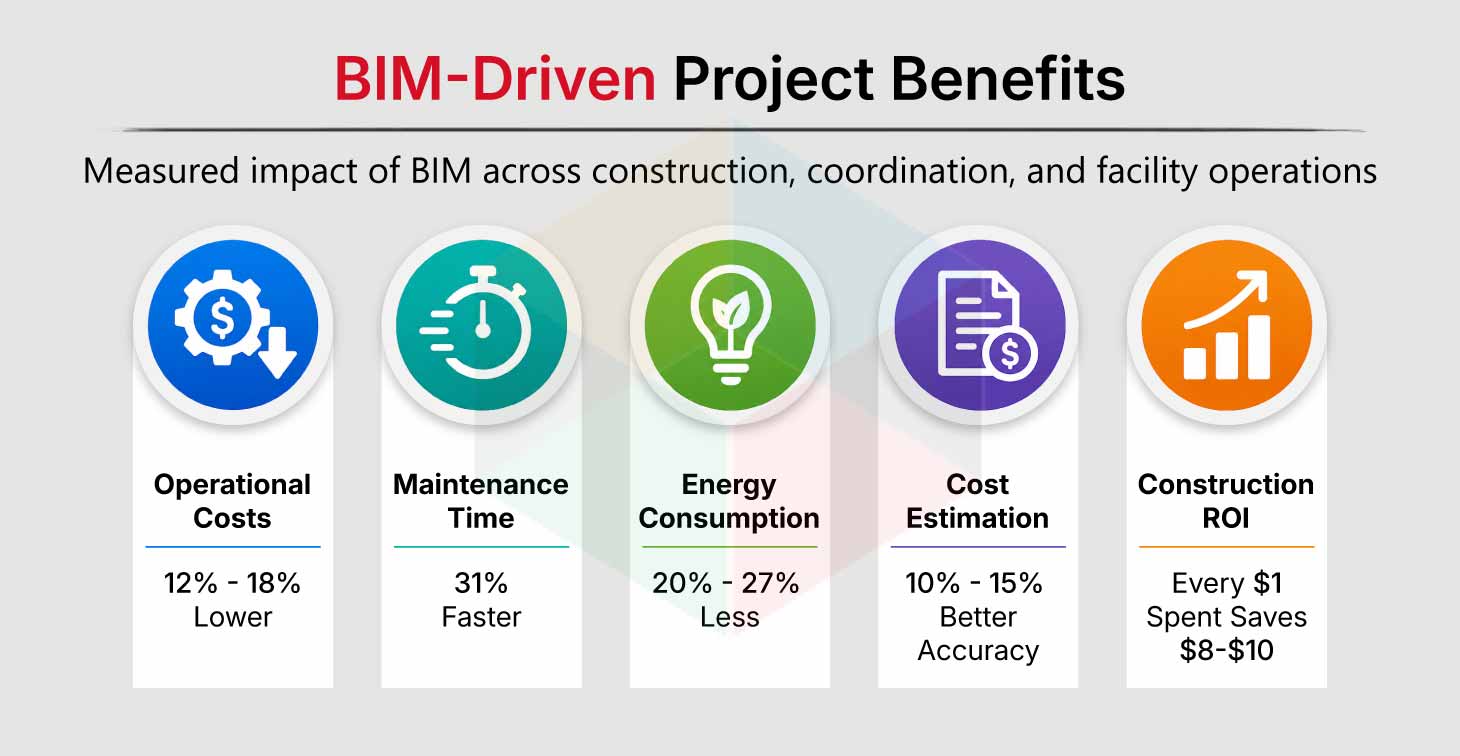
For MEP specifically, this translates into faster fault diagnosis, more efficient preventive maintenance, and more informed decision-making when planning upgrades or retrofits.
Common Gaps in BIM Handover
Even projects using BIM can still produce weak handover deliverables when teams ignore information management during execution.
Three gaps appear repeatedly across projects.
Poor Data Structuring
Many BIM handover issues begin with unstructured information instead of missing models. When teams use inconsistent naming conventions, asset IDs, and parameter standards, facility teams still need to reorganize data manually after project closeout.
Common problems include:
- Missing classification codes
- Inconsistent asset IDs
- Non-standard parameter names
- Incomplete maintenance data
This is why teams delivering MEP BIM coordination services now manage information structure alongside model coordination to support facility operations from the beginning.
Lack of Standards
BIM workflows depend on shared standards across all project stakeholders. Problems usually appear when teams lack defined exchange protocols, naming conventions, and information requirements.
Standards such as ISO 19650 help teams organize:
- Common Data Environment workflows
- Information containers
- Model naming conventions
- Document approval processes
Without consistent standards, model federation and CAFM integration become difficult even when the geometry looks coordinated.
Incomplete Models
Some handover models appear complete visually but still lack critical operational information. Facility teams then struggle to use the model effectively after occupancy.
Typical gaps include:
- Missing warranty information
- Simplified MEP systems
- Incomplete asset metadata
- Unverified field revisions
Owners and project teams must define required LOD and information content early so teams can validate model completeness before handover instead of discovering gaps after occupancy.
Conclusion
MEP handover problems do not generally begin during project closeout. Most issues develop gradually throughout construction when drawings, asset data, warranties, and field revisions remain disconnected across teams. As a result, facility managers inherit incomplete records that create operational problems long after occupancy.
BIM changes this process by connecting geometry, documentation, and asset information throughout design, coordination, construction, and handover. Instead of receiving disconnected PDFs and outdated as-builts, owners receive coordinated digital records that reflect actual site conditions. The process still depends on disciplined execution. Poor data structuring, incomplete models, and weak standards can reduce the value of BIM handover significantly. Teams must define information requirements early, maintain accurate updates throughout construction, and validate model completeness before project closeout.
This becomes especially important for complex projects involving MEPF coordination for residential building, where accurate operational data directly affects long-term maintenance, renovations, and facility performance.

Looking to streamline your MEP handover with BIM?