+1 (409) 800-6601
 contact@virtualbuildingstudio.com

Mechanical, electrical, plumbing and Fire safety systems account for 40-60% of total construction costs on commercial projects. Contractors face mounting pressure to win competitive bids and execute within budget in a market where every dollar counts. The shift to BIM for MEP Cost Estimation directly addresses this pressure. Estimators extract verified quantity data from intelligent 3D models rather than counting components from 2D drawing sheets. Every duct segment, pipe run, and mechanical fitting carries embedded parameters dimensions, material type, and cost code. These parameters stand ready for extraction the moment a Revit schedule runs.
This shift transforms how contractors approach project finances from preconstruction onward. Accurate quantity data from the model allows procurement teams to issue targeted RFQs. Teams negotiate volume pricing with suppliers and lock in material costs before construction begins. Subcontractor bids gain grounding in real geometry rather than rough estimates from incomplete plans. Owners receive cost breakdowns that trace directly to model elements, improving trust and reducing scope disputes at every milestone. Contractors who adopt this workflow position themselves ahead of the market. They deliver budgets with measurable accuracy and execute projects with tighter financial control from groundbreaking to handover.
Challenges of Traditional MEP Cost Estimation Methods
Traditional MEP cost estimation relies heavily on manual processes and fragmented information sources. While these methods have been industry standard for decades, they struggle to keep pace with the complexity of modern commercial buildings. As project size and system density increase, these limitations expose contractors to significant financial and operational risk.
Manual Quantity Takeoff Errors
Estimators measure duct runs, count fittings and transfer pipe lengths from 2D drawings into spreadsheets by hand. Each manual step introduces cumulative error. Missed components and transposed figures compound across trade systems, producing quantity shortfalls that inflate final project costs beyond original budget projections.
Disconnected Drawing Sets
A mechanical plan, electrical plan, and plumbing plan each show one system in isolation. Both systems occupy the same ceiling space, yet they appear on separate drawing sheets. Estimators evaluate each drawing independently, missing spatial conflicts that translate directly into costly rework during construction.
Version Control Failures
Project drawings update frequently during design development. An estimator works from one revision and a project manager reviews a different version. These gaps create quantity discrepancies between the bid and the actual scope. Material orders arrive short, and additional purchases erode project margins without warning.
Delayed Conflict Detection
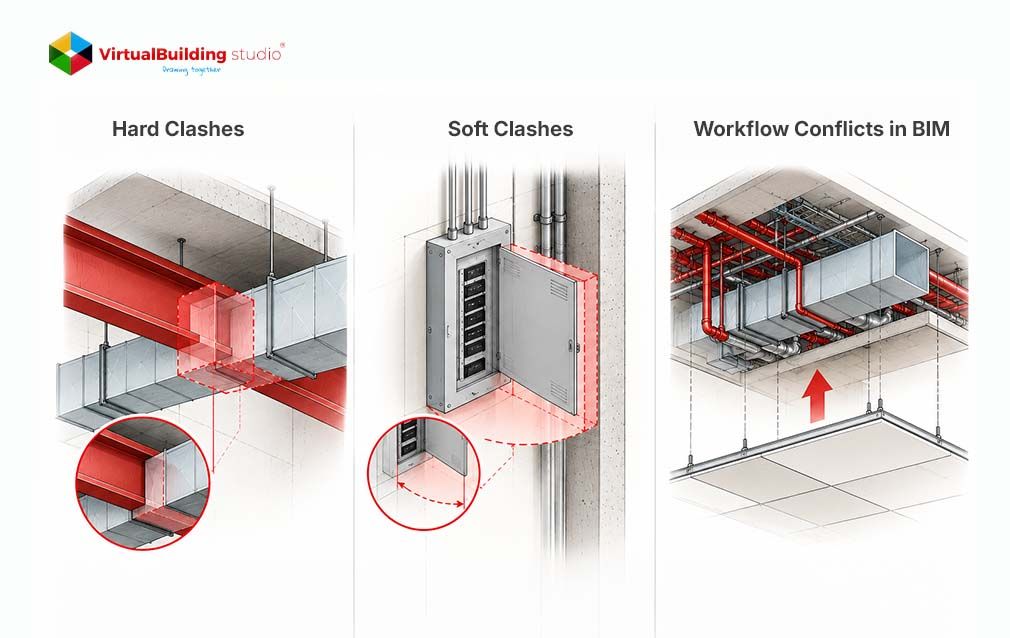
Without 3D visibility, clashes between MEP disciplines remain hidden until installation begins. A mechanical duct and an electrical conduit fighting for the same ceiling space generates a field rework order. Each field resolution costs five to ten times more than a coordination correction during preconstruction.
Fragmented Stakeholder Communication
Traditional workflows scatter cost data across individual estimators, project managers, and subcontractors. Each party maintains a separate spreadsheet, disconnected from the live design. Decisions at one level fail to reach others in time, producing cost inconsistencies that surface as overruns after award.
How BIM Improves Accuracy in MEP Quantity Takeoffs
A production grade Revit MEP model carries geometry that mirrors the actual installation. Every duct segment holds a defined length, width, height, and material specification. Every pipe carries a diameter, insulation grade, and connection type. MEP BIM Services platforms automate the extraction of "True Quantities" directly from this 3D geometry. When a designer modifies duct routing in Revit, all associated schedules update automatically. The estimator always works from current, model-verified data. a capability that manual workflows lack at every project scale.
Revit quantity schedules pull exact duct lengths, fitting counts, valve lists, and pipe support totals automatically
- Real-time design changes update all associated cost schedules without manual re-entry
- Granular cost tracking assigns unit costs to each MEP component type directly within the model
- Estimators review costs by floor, system type, or construction phase using a single schedule export
- Phased procurement plans draw directly from model quantities, reducing last-minute purchasing and material waste
- Automated Uniformat or Master format classification codes organize exported data for immediate use in cost platforms
This level of quantity accuracy transforms estimation from a reactive process into a proactive one. Project managers gain visibility into cost distribution by building zone, enabling value engineering conversations during design rather than after award. Procurement teams issue purchase orders with confidence, knowing that quantities trace directly to verified model geometry. The estimation team reduces hours spent on rework and focuses time on strategic cost analysis and supplier negotiation.
Role of 3D Modeling in Cost Visualization and Planning
3D BIM models give contractors a clear view of cost distribution across the entire building envelope. High-density MEP zones such as mechanical rooms, vertical shafts, riser corridors, and ceiling plenums which appear immediately in the model view. Estimators identify these zones before submitting a bid and apply appropriate contingency buffers to protect project margins. Cost scenario simulation adds strategic depth. A contractor can model two HVAC routing options in Revit and extract quantities for each scenario. Total material and labor costs then appear side by side for direct comparison. The decision comes from hard data extracted from real model geometry rather than assumptions from 2D plan sets.
Visual models give client communication a clarity well beyond what spreadsheets offer. When a contractor presents a 3D cost visualization during bid review, the client sees exactly where money goes. Budget allocations trace to specific systems, floors, and construction phases with complete transparency.
This transparency reduces scope disputes, manages owner expectations, and builds long-term trust that extends beyond a single project. The model becomes a shared reference point for all cost conversations. It replaces fragmented email threads and conflicting spreadsheet versions with one geometry backed source of truth. All parties access and verify this data in real time.
4D scheduling links construction sequencing with cost timing in a way that 2D planning tools consistently fail to deliver. Contractors attach construction schedules to model elements, creating a time phased view of MEP installation activity and its associated costs. Procurement orders align with the installation sequence, so material purchases arrive on site when crews need them. Storage costs drop.
Cash flow improves. Trade contractors gain advance notice of their installation windows. They mobilize labor and materials at precisely the right project stage, keeping the schedule and cost plan aligned throughout construction.
Benefits of BIM for Contractors in Cost Control and Budgeting
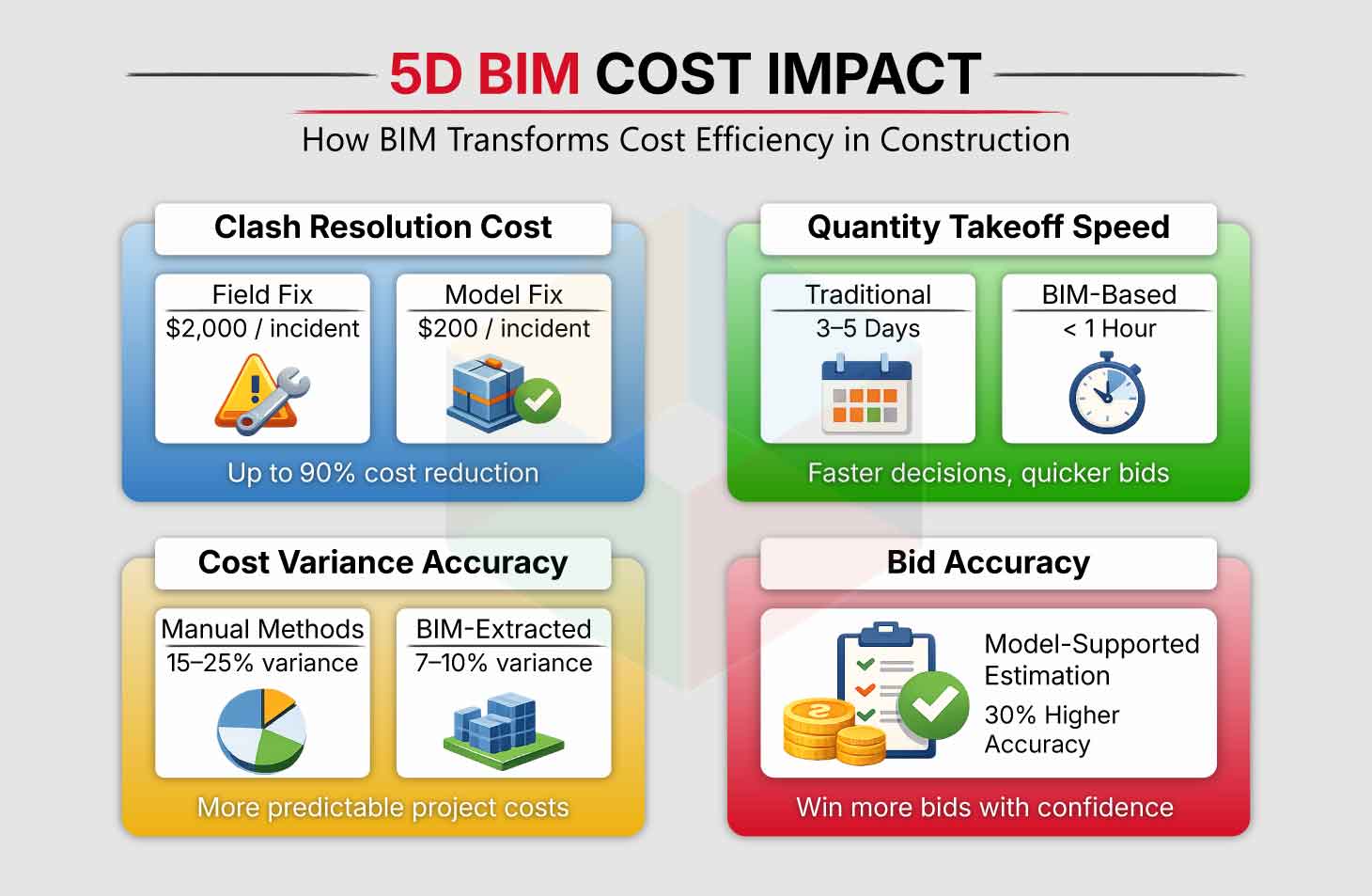
BIM Cost Estimation for Contractors delivers measurable financial results across the full project lifecycle. Research on model-extracted estimation projects showed an 18% reduction in cost variance compared to manual methods. Research in Automation in Construction (2023) recorded a 22% drop in procurement overruns. Those commercial MEP projects all applied 5D BIM Cost Estimation workflows. BIM-supported bids achieve 30% higher accuracy than spreadsheet methods. MEP BIM for Construction workflows extends these advantages into modular and prefabrication programs. Fabricators receive accurate spool drawings and cut sheets directly from the model.
Key Contractor Benefits:
- 18% cost variance reduction on projects using model-extracted quantity estimation
- 22% fewer procurement overruns in commercial MEP projects using 5D BIM workflows
- 30% higher bid accuracy compared to traditional spreadsheet estimation methods
- Real-time cost updates the cost plan updates automatically on every model revision
- Lifecycle cost visibility component-level cost codes support long-term operational budgeting
- Prefabrication efficiency, accurate spool drawings reduce material waste and field labor costs
Integration of BIM with Estimation and Project Management Tools
Data flows from Revit models into estimation software through structured export formats such as Excel files, CSV tables, and IFC data packages. Cost estimation platforms such as CostX, ProEst, and Sage Estimating import these files and apply regional pricing databases automatically. BIM Estimation Services teams configure these pipelines during the preconstruction phase.
The connection between model geometry and cost output runs without interruption across the full project. Cost software outputs then flow into project management platforms like Procore or Oracle Primavera P6. Each platform receives live data from the same model source. All project stakeholders stay synchronized on current quantities and costs at every project stage.
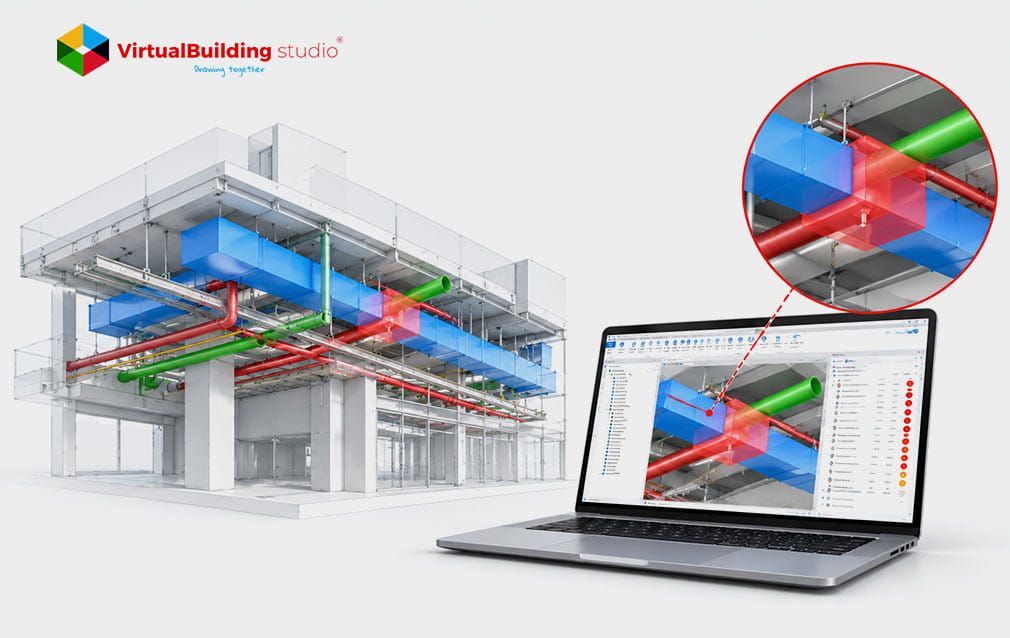
Navisworks adds a critical clash detection layer to this estimation workflow. Estimators run clash reports before finalizing quantities. The report flags unresolved spatial conflicts between MEP systems across the full model. The estimating team adds contingency allowances for identified coordination corrections. This proactive step prevents last minute budget adjustments during construction and removes surprises from the procurement process.
Dynamo scripts further automate repetitive MEP tasks within the Revit environment. One script renames all elements to match the project cost classification system. A second checks model completeness against the BIM execution plan. A third batch-exports schedules to the cost platform without manual intervention, saving many hours during estimation preparation.
Cloud-hosted BIM platforms Autodesk Construction Cloud and BIM 360 provide centralized, permission-controlled access to the live project model. A project manager in the field and an estimator at their desk access identical model data simultaneously. An owner reviewing a bid sees the same live data as both.
This removes version conflicts from the estimation process. BIM for Construction Cost Planning workflows use COBie data exports to carry component specifications forward into facilities management systems. The model serves the project from preconstruction through occupancy, producing value at every stage of the building lifecycle.
Best Practices for Implementing BIM in MEP Cost Estimation
Standardizing Revit families forms the foundation of any successful MEP estimation workflow. Every MEP family must carry correct parameter fields for cost data, material specifications, and classification codes. This applies to duct fittings, pipe fittings, panels, valves, and all supporting components. A consistent naming structure for MEP systems allows estimation software to sort quantities by type and location without manual reformatting.
Teams adopt Uniformat or Master format classification codes as Revit family parameter values from project start. This practice eliminates manual re-sorting of exported data. Model LOD must match the estimation stage. LOD 200 supports schematic-level cost planning. LOD 350 supports detailed procurement-level and fabrication-level estimates. Teams that perform detailed estimation on LOD 200 models encounter component data gaps. These gaps produce inaccurate bill-of-materials outputs and undermine the entire cost plan.
AI-driven Cost Estimation in Construction tools now connect directly to BIM models through open APIs. These tools analyze historical project data and apply predictive pricing to current model quantities. Contractors gain a second layer of cost intelligence that extends beyond published price books and regional cost indices. Regular model audits protect estimation quality throughout design development.
An audit verifies that all MEP elements carry complete parameter data. It confirms the absence of duplicate geometry. It checks that clash resolution records remain current and documented. Monthly audits keep the cost plan accurate as the design advances through each LOD stage. Team training rounds out the implementation plan. Estimators who understand Revit schedule functions extract better data from the model.
BIM managers who understand cost workflows build models that serve estimation from day one. Cross-discipline training across estimation, coordination, and project management teams produces the strongest project outcomes.
Conclusion
BIM transforms MEP cost estimation from a manual, error-prone process into a model-verified discipline. Contractors who adopt BIM estimation workflows produce more accurate bids and detect conflicts earlier. They connect procurement to real model geometry and deliver projects within tighter budget margins. The measurable outcomes, reduced cost variance, higher bid accuracy, and fewer change orders appear consistently across project types.
These results hold across hospital campuses, high-rise towers, industrial facilities, and modular programs alike. As MEP systems grow more complex and owner expectations rise, model-informed estimation becomes a standard requirement. Teams that master this workflow today gain a durable operational advantage on every future project they pursue.

Take the Next Step in MEP Cost Accuracy