
The decision between in-house vs outsourced architectural drafting defines how every AEC firm converts design concepts into construction-ready documentation. Every plan, section, elevation, BIM model, and coordination set carries structured data. That drives procurement, fabrication, and construction execution across the full project lifecycle. Firms operating in LOD 300–500 environments and ISO 19650 information standards select their production model with direct consequences for overhead ratios, delivery velocity, and technical output quality across every commission they accept.
Rising labor costs in US markets, accelerating Autodesk subscription fees, and an acute shortage of qualified BIM coordinators add urgency to this decision. Architecture firms that match the right production model to their project mix operate at lower cost per deliverable ratios, compress milestone timelines, and position themselves to win larger, more demanding commissions. This blog provides a detailed technical comparison of cost, speed, quality, scalability, and long-term strategic impact. It equips senior architects and BIM managers with a clear, data-driven decision framework based on real production insights.
Understanding In-House Architectural Drafting vs Outsourced Drafting
An in-house drafting team functions as an embedded production unit within the architectural firm with full ownership of drawing standards and BIM model integrity. It maintains documentation continuity from concept through to as-built delivery. Architectural Drafting Outsourcing functions as a remote extension of the main office. Specialized external teams handle documentation and BIM modeling using cloud-based platforms and structured data exchange systems. Deliverables are returned through version-controlled submissions aligned with project milestones.
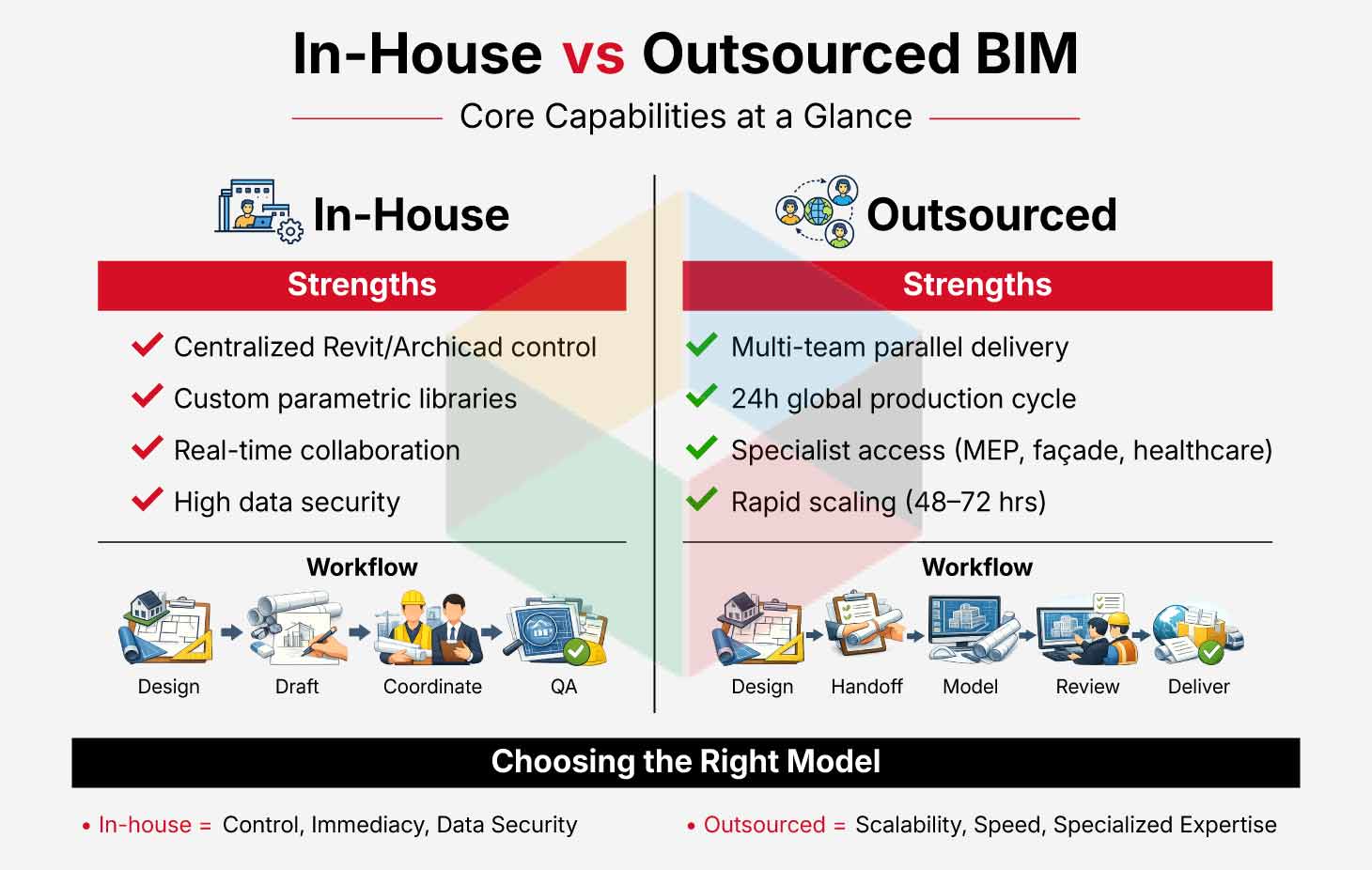
Both models serve the same core objective of transforming design intent into technically accurate, standards-compliant construction documentation. The selection between them depends on project scale, confidentiality requirements, deadline intensity, and the firm's strategic capacity goals for each phase of the commission.
Why Many U.S. Architecture Firms Are Reconsidering In-House Drafting Teams
Rising Fixed Cost Burden
In-house drafting teams’ function as cost centers, absorbing fixed overhead regardless of project volume.A fully staffed internal production team of six mid to senior drafters in a US market generates $480,000–$720,000 in annual salary expenditure. Additionally, software subscriptions, hardware refresh cycles, and training programs add a further $40,000–$80,000 in annual technical overhead per team. This fixed structure consumes budget at equal intensity across peak commissions and quiet periods alike.
Demand Volatility and Utilization Inefficiency
Project inflow fluctuates across every practice. During peak phases, in-house teams operate under overload conditions with compressed review cycles and elevated burnout risk. During project gaps, the same team generates zero billable output at full salary cost, a pattern that creates structural utilization inefficiency. The inherent inability of a fixed team to match elastic project demand and eroding per-project profitability across the annual portfolio.
Talent Shortage and Retention Challenges
Skilled BIM coordinators and senior Revit modelers rank among the most in-demand professionals in the 2026 AEC labor market. A survey of over 600 AEC professionals in North America found that just 22% of firms reported a drop in turnover in 2023 compared to 2022. The attrition rates in technical and design production roles persist well above the broader industry average. A separate Quire survey of US-based AEC firms found that 84% of respondents reported challenges recruiting new employees. 70% of respondents identified turnover as a key factor in labor shortages, leading to instability in drafting knowledge and increased HR management costs across offices.
Shift Toward Value-Based Work
Forward-thinking firms want senior architects engaged in design innovation, client relationship management, and competitive positioning activities that generate direct revenue and build practice reputation. Production oversight of large CD sets consumes principal-level hours that firms invest more effectively in design leadership, competition submissions, and client acquisition. Firms that free this capacity report measurably higher win rates in competitive tender environments within 12–18 months.
Technology Enablement of Distributed Workflows
Cloud collaboration platforms BIM 360 and Autodesk Construction Cloud have made distributed production workflows operationally identical to internal workflows. Remote teams access the same central models, contribute to the same worksets, and submit through the same CDE as in-office staff, removing the geographic friction that once constrained the quality and speed of external production.
Cost Comparison: In-House Drafting vs Outsourced Drafting Services
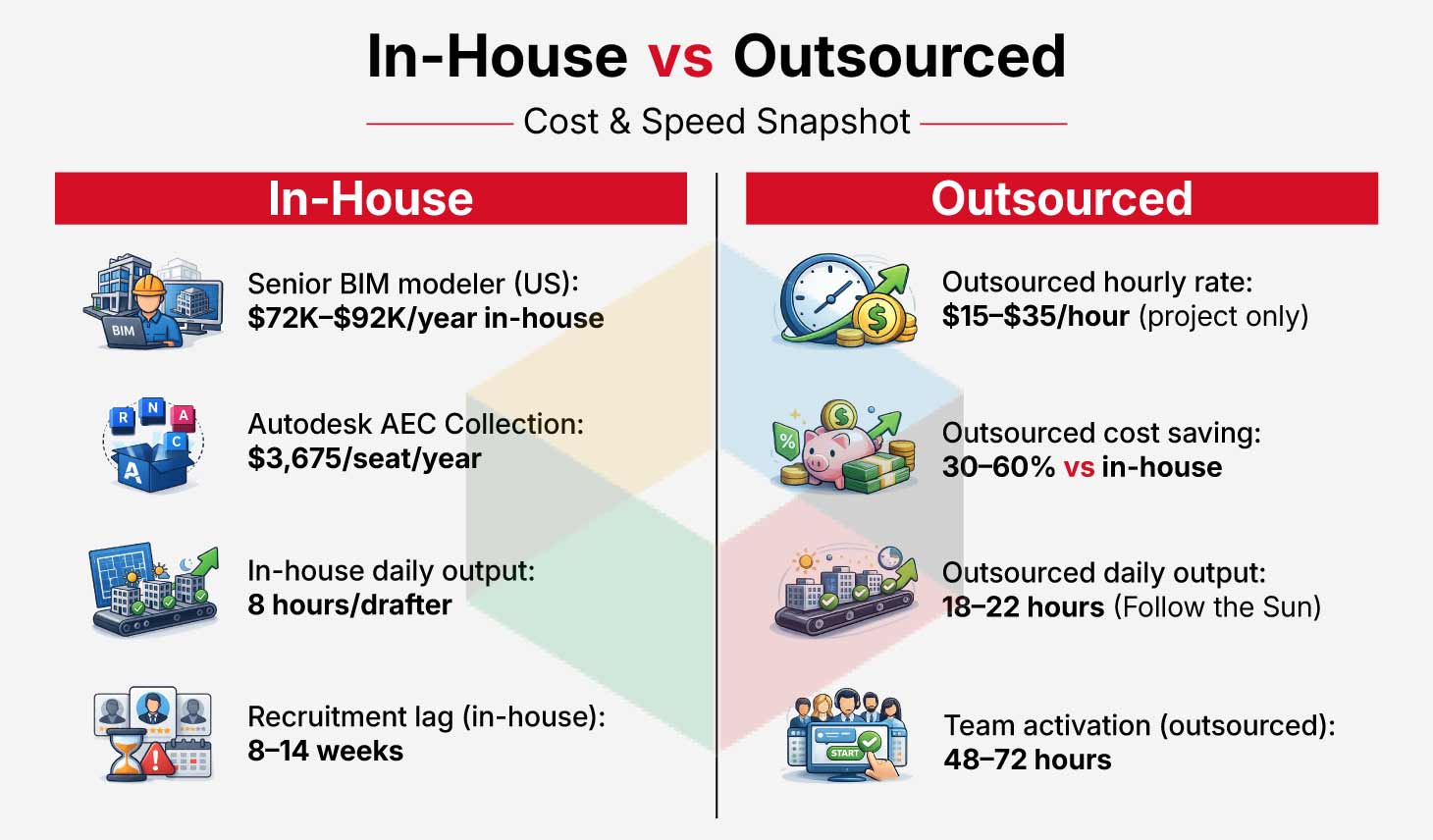
The financial gap between in-house vs. outsourced architectural drafting runs deeper than headline salary figures suggest. Maintaining an internal drafting team requires a multi-layered financial commitment spanning direct, indirect, and hidden costs. Expenses include salaries, software licenses, high-performance hardware, office space, recruitment, and turnover-related replacement costs. These costs continue to accumulate on the firm’s P&L regardless of workload, even during periods of underutilization between projects.
| Factor | In-House | Outsourced |
|---|---|---|
| Senior drafter's annual cost | $72K–$92K + benefits | $15–$35/hour, project only |
| Software licenses | $3,675/seat/year (client-funded) | Included by the partner |
| Hardware investment | $4,500–$9,000 per unit | Zero |
| Team activation speed | 8–14 weeks recruitment | 48–72 hours |
| Cost during project gaps | Full salary continues | Zero |
| Production cost saving | Baseline | 30–60% reduction |
Architectural CAD drafting services operate on per-hour billing, per-project fixed pricing, or dedicated team retainer models, converting production expenditure from a fixed annual overhead into a variable cost that activates at project award and scales down at completion. Industry benchmarking consistently places total production cost reduction at 30–60% compared to equivalent in-house capability, giving firms a direct path to protect profit margins on every commission without compromising output quality or delivery speed.
Speed and Project Turnaround: Which Model Delivers Faster?
In-house teams deliver immediate iteration speed on focused revisions; a design change requiring three redrawn elevations returns to the design team within 2–4 hours when the production drafter occupies the same office. This immediacy advantage performs best during active design development phases where architecture and interiors teams iterate in tight feedback cycles. The capacity constraint appears at scale: in-house teams operate within a fixed 40-hour weekly production window per drafter, pause revision cycles overnight and across weekends, and face bottlenecks when multiple project deadlines converge on the same team simultaneously.
CAD drafting services providers structured across global time zones execute the Follow the Sun production methodology, advancing drafting tasks through three sequential geographic shifts across a single calendar day and delivering 18–22 active production hours with zero overtime cost to the client firm. A 200-hour Revit modeling task requiring five working weeks from a single-shift in-house drafter can be completed in 9–11 calendar days under this model. A New York firm transmits marked-up plans at 5:30 PM EST and receives updated Revit models at 9:00 AM EST the following morning, with full overnight production advancement at zero internal resource cost.
| Shift (UTC) | Region | Task Focus |
|---|---|---|
| 06:00–14:00 | East Asia | Floor Plans, Sections, Massing |
| 14:00–22:00 | South Asia | RCPs, Details, Annotation |
| 22:00–06:00 | Eastern Europe | QC Pass, Coordination, Review |
Quality and Accuracy in Architectural Drafting Workflows
In-house teams deliver quality through direct supervisory proximity, standardized template libraries, and immediate correction cycles running throughout every production day. Senior architects and BIM managers intervene in real time when output deviates from project intent, a feedback immediacy built on deep institutional knowledge, familiarity with client preferences, jurisdictional constraints, and firm-specific drawing standards that external partners align with through structured onboarding during the project setup phase.
Professional architectural CAD drafting services providers at the specialist tier operate with dedicated QC departments functioning structurally independent from the production team. A separation that creates a four-stage technical verification pipeline that most in-house teams replicate with difficulty under standard staffing structures.
Stage 1: Automated Model Auditing
The QC team executes Revit model health checks through Ideate BIMLink and Dynamo audit scripts, running redundant element detection and purge protocols to bring file sizes to sub-300MB targets per linked model, reducing critical warnings to fewer than 50 per file, and validating workset structure and linked model organization before every transmittal cycle.
Stage 2: Naming Convention Audits
Reviewers verify sheet naming against company-defined numbering logic, confirm view naming alignment with BIM Execution Plan taxonomy, validate workset naming against ISO 19650 container conventions, and audit parametric family naming against the BIM content library to confirm data integrity at every object level. Download Your BIM Execution Plan to align your project governance framework with professional production standards before external partner onboarding.
Stage 3: Automated Clash Detection
The QC team runs Navisworks Manage batch processing across all discipline models, applying structural-to-MEP 25mm and MEP-to-MEP 50mm clearance tolerances as standard thresholds, generating hard clash, soft clash, and clearance clash matrices with priority assignments per discipline, and submitting clash log reports with every transmittal to track open and resolved issues across active review cycles.
Stage 4: Drafting Standards Compliance
Reviewers verify line weights against client-specific CTB and STB plot tables, audit annotation text heights, leader geometry, and dimension string alignment across all sheets, and cross-reference door schedule parameters, window type marks, and room data values against the project specification matrix, catching parametric data mismatches before they surface during the quantity surveying phase and generating costly rework.
When Should Architecture Firms Choose Outsourced Drafting?
High-volume commercial commissions requiring 500+ hours of Revit documentation present the strongest business case for outsourced production. Peak workload periods where in-house capacity reaches saturation, multi-project environments demanding simultaneous production across three or more active commissions, and aggressive permit submission dates where Follow-the-Sun velocity compresses five-day milestones into three calendar days all represent ideal conditions for activating an external production partner.
CAD drafting services for architects deliver particular depth in healthcare and laboratory sectors, where HTM 08-03 compliance detailing and ISO 14644 cleanroom clearance geometry demand specialist knowledge that generalist in-house teams build only through years of dedicated sector investment.
The optimal architecture for 2026 high-output firms combines both models through a deliberate hybrid structure: the core in-house team carries design leadership, BIM standards management, client coordination, and sensitive project documentation, while the activated outsourced capacity handles large-scale CD production, specialist detailing, and deadline-critical documentation packages. Architectural drafting outsourcing in this hybrid structure functions as a controlled production extension elastic enough to absorb major commercial workloads at project award and scale down cleanly at phase completion, free from long-term overhead commitments that erode annual margins.
The Future of Architectural Drafting: AI, Automation, and Remote Teams
Artificial intelligence now accelerates core drafting production tasks that previously demanded full working days of manual Revit input. Generative design platforms produce compliant floor plan configurations from parametric constraint sets in minutes. AI-assisted annotation systems auto-populate room labels, door tags, and dimension strings directly from model data, eliminating manual annotation tasks that previously consumed 15–20% of a drafter's daily production capacity.
Automated sheet population through Dynamo scripts, error detection algorithms flagging disconnected wall joins, incomplete door schedules, and parametric family generation from manufacturer specification data all reduce the manual labor intensity of large CD sets and redirect production capacity toward higher-value coordination and detailing work.
Full-lifecycle BIM at LOD 400–500 extends drafting scope into facility management and digital twin environments, with COBie data embedded in every model object for FM handover, IFC 4.x compliant exports for open BIM platform compatibility, and 4D simulation links connecting model elements to construction program sequences for site logistics and procurement scheduling.
The permanent normalization of remote AEC work is sustained through cloud-hosted central models, real-time version control, and distributed access permission architecture. Positions the AI-enabled, globally distributed drafting ecosystem as the production standard for the most competitive 2026 architecture practices. Firms that build flexible, hybrid production models today occupy this ecosystem with full operational capability at project speed.
Conclusion
In-house drafting anchors the firm's parametric content libraries, drawing standard ownership, and long-term client continuity within a centralized production environment delivering direct supervisory control, deep institutional knowledge, and maximum data security across every production day. Outsourced drafting provides scalable capacity, round-the-clock productivity, specialized expertise, and flexible cost structures that shift fixed overhead into project expenses. This accelerates timelines and expands a firm’s technical capabilities across sectors at a fraction of the cost of in-house resources.
The most effective architectural production strategy combines both models with clear strategic intent. A lean in-house team leads design and BIM standards while outsourced teams support large-scale documentation and deadline-critical phases. This hybrid structure delivers maximum cost efficiency, maximum production speed, and maximum quality consistency across every project type, scale, and market sector and positions the firm to treat production capacity as a strategic variable that scales with project opportunity rather than a fixeds annual overhead eroding margins across the full financial year.