
The AEC industry faces persistent challenges. Project teams remain fragmented. Cost overruns occur frequently. Schedules slip. Information exchange lacks consistency. Designers, engineers, contractors, and owners generally work in parallel, not in coordination. They depend on disconnected tools and workflows. That setup limits transparency. Projects grow more complex. These inefficiencies multiply. Financial risk rises. Predictability falls. Many firms have adopted digital tools. Digitization alone has not eliminated silos. Project data is frequently recreated across phases. Valuable information is lost between design, construction, and operations. The industry’s struggle is no longer about adopting technology. The struggle is about using it systematically.
Building Information Modeling offers a more integrated approach. BIM creates a shared digital representation of a building construction project. Teams use that representation for coordinated decision-making, improved visualization, and lifecycle planning. Meaningful results depend on organizational process maturity. Maturity is defined through BIM maturity levels. Those levels evaluate how teams create, manage, and exchange structured project information. As firms advance, collaboration becomes more consistent. Outcomes become more predictable. Many organizations engage BIM Modeling Services. They standardize workflows, improve coordination, and align digital deliverables with project goals.
In this blog, you will learn what each maturity stage represents. And how advancing BIM maturity levels can strengthen performance across the project lifecycle.
What Are BIM Maturity Levels?
BIM maturity levels determine how project teams can manage, create, and exchange digital information across the various stages of a building construction project.
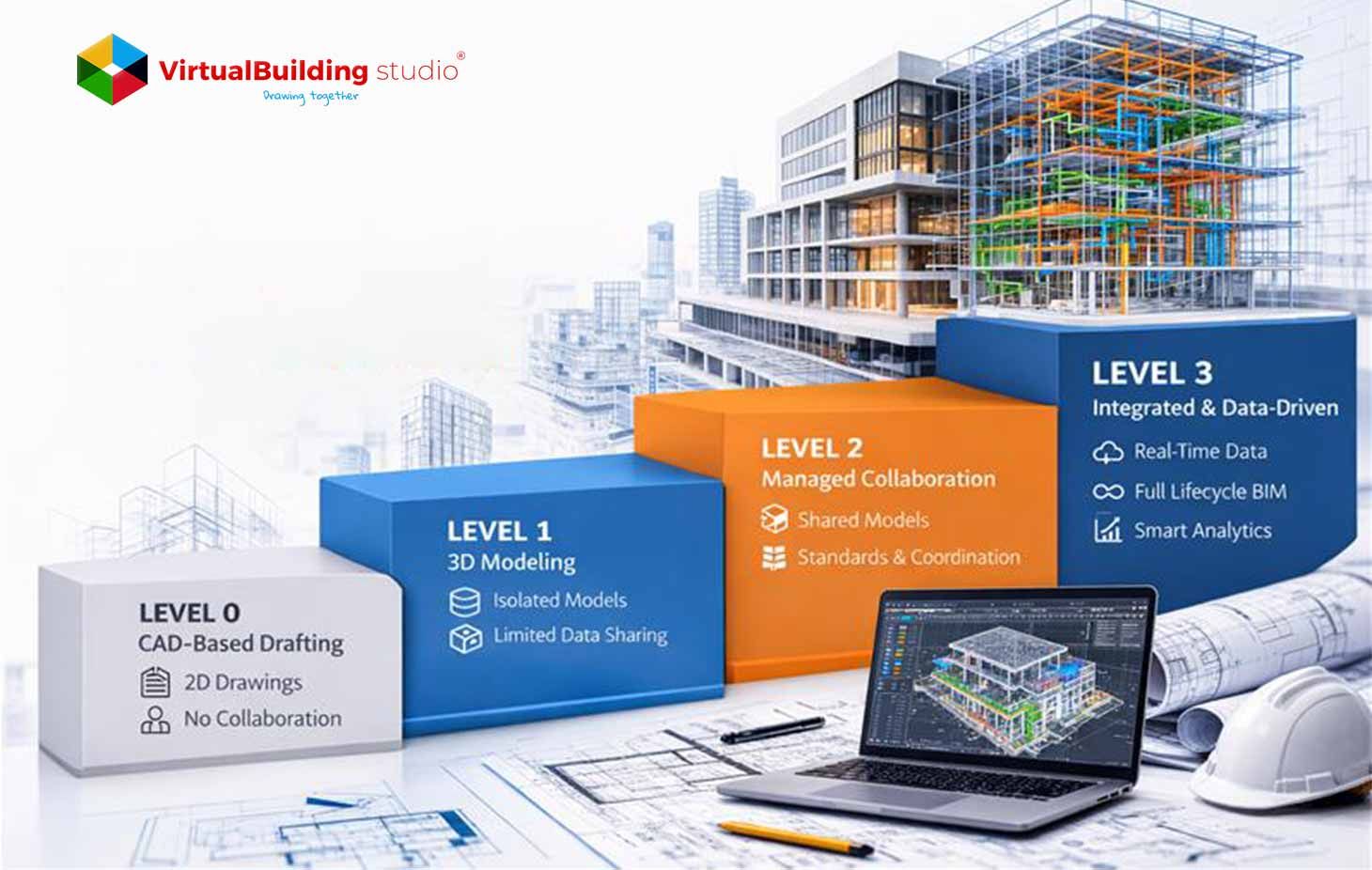
The original Level 0–3 wedge emerged in the UK as a strategic communication tool. It outlines a shift from isolated digital drafting toward integrated, data-rich collaboration. However, U.S. organizations rely on formal frameworks such as the National BIM Standard - United States (NBIMS-US) Capability Maturity Model to measure real capability.
The difference is important. The wedge helps teams explain a roadmap. The NBIMS-style model lets an owner verify whether teams actually meet requirements for policy, process, and data. U.S. public-sector guidance, such as GSA guidance and FHWA roadmaps, then tie those measures to specific deliverables for procurement.
When firms discuss Digital construction maturity internally, they are often blending both ideas. They use Level 0-3 as narrative shorthand while using capability models to justify investments in process, policy, and staffing.
Understanding that difference prevents two common mistakes:
- Claiming Level 2 capability without measurable processes
- Confusing model detail with organizational maturity
- Now that the framework is clear, let’s ground it in reality. Let’s begin with the baseline most firms grew from.
BIM Level 0: Traditional 2D CAD Workflows
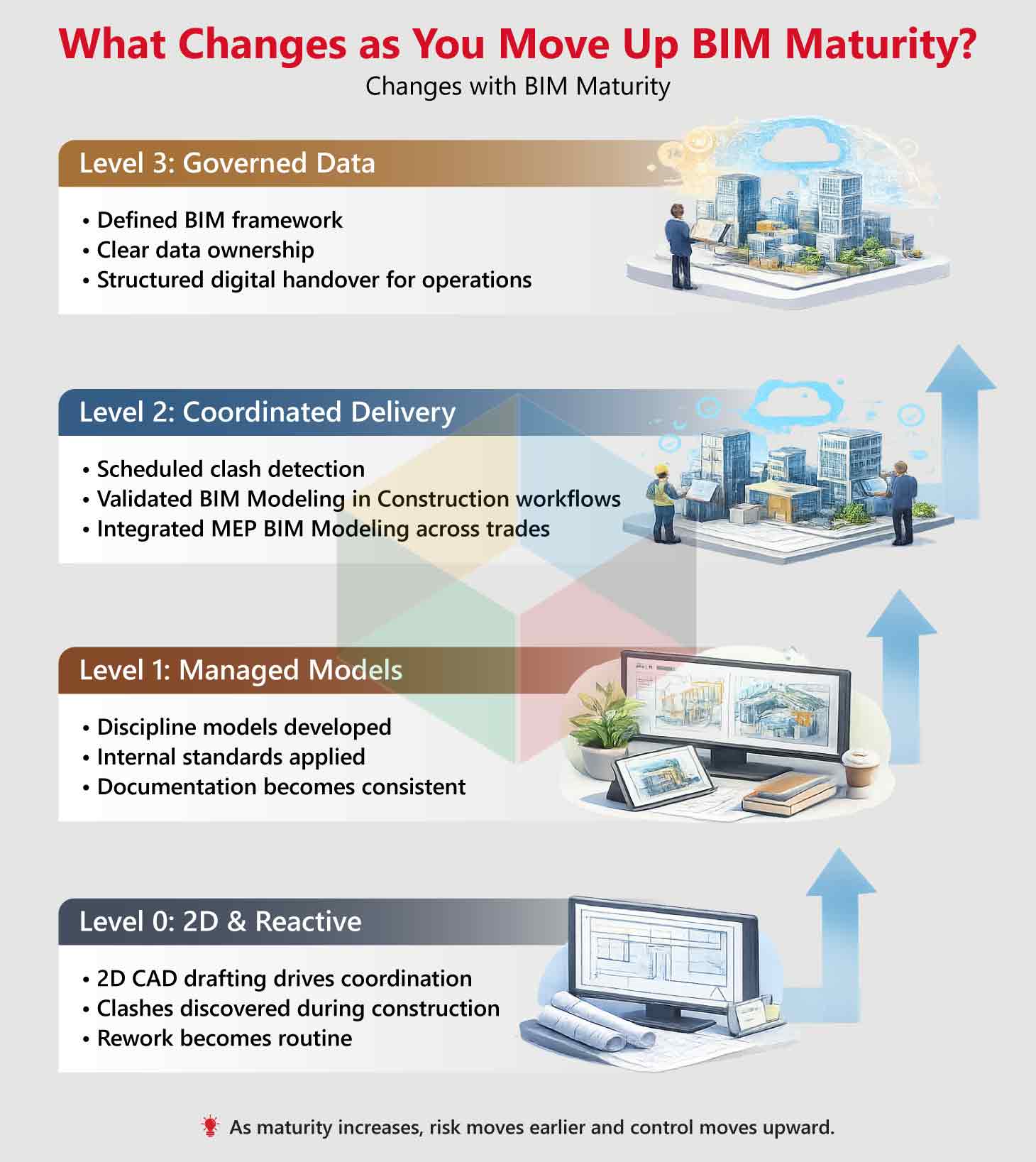
If the wedge starts as a roadmap, Level zero is the origin point on that map. Level 0 looks like the digital analog of drafting on trace. Software is used, but information remains graphical and project teams do not share structured data.
At Level 0, deliverables are drawing sets produced through 2D CAD drafting. Each discipline issues its own DWG and PDF files, and coordination depends on markups and review meetings. Because objects do not carry attributes, teams cannot reliably extract quantities, nor can facilities staff rely on models for asset data. That shortcoming increases rework when contractors must translate drawings into field assemblies.
If your current procurement asks only for sheets and PDF submittals, your practice functions at Level 0. Moving away from this baseline requires choosing contractual deliverables that accept model files and define how model information will be managed. The next section explains what that first set of rules looks like in practice.
BIM Level 1: Managed CAD and Data Sharing
Building from Level 0, the immediate improvement is management. Level 1 retains drawing-based deliverables but introduces standards and basic control. That change reduces avoidable errors without upending contract templates.
At Level 1, firms publish CAD standards for layers, naming, and plotting. Some disciplines produce 3D models to test geometry and resolve local conflicts, but they do not present models as the contractually authoritative deliverable. Project files live on a shared drive or a lightweight Common Data Environment, and versioning rules are ad hoc. Because BIM Modeling Services, at this stage, are often offered as optional extras. Procurement still awards on drawing quality rather than on structured data handover.
This stage improves consistency but does not yet raise Digital construction maturity to a point where model data is reused for downstream purposes such as facility management. To reach that level, teams must formalize exchange protocols. And schedule coordinated model federations, which is the topic of Level two.
BIM Level 2: Collaborative Modeling and Coordination
Contrast clarifies the leap: Level 2 stops treating models as internal aids and makes discipline models contractually recognized deliverables. That shift causes teams to define roles, schedules, and exchange formats.
Core behaviors at Level 2 include:
- Discipline teams author object-based 3D models.
- Teams run scheduled federations and clash detection in a Common Data Environment with approval states.
- A BIM Execution Plan sets responsibilities, model uses, and exchange formats.
- Owners ask for open-format exports such as IFC and COBie to support handover and asset data.

That disciplined practice yields measurable benefits. Most large projects suffer cost and schedule overruns. Industry analysis shows such projects typically take about 20%longer than scheduled and can be up to 80%over budget. Early clash detection through coordinated modeling directly addresses those inefficiencies.
With Level 2 behaviors in place, BIM Modeling in Construction shifts from marketing copy to operational practice. Bidders must demonstrate repeatable coordination, validated deliverables, and documented handover processes. The next section describes the aspirational target beyond federation.
BIM Level 3: Fully Integrated and Cloud-Based BIM
Level 2 reduces gaps created by periodic exchanges. And level 3 proposes to remove those gaps entirely by making the model the authoritative single source of truth. That aspirational state demands governance and contractual clarity.
At Level 3, multiple teams work inside a single, integrated information environment where changes are visible in near real time and model data is structured from the outset to support operations. Owner-defined data dictionaries, classification systems, and APIs connect project models to facilities and asset management systems. The result is a persistent asset information model that supports lifecycle decisions.
Digital construction maturity reaches new functional territory at Level 3. Operations teams consume asset-ready data directly from delivery models. This state requires updated procurement practices. Procurement must assign model ownership, clarify approval gates, and support persistent model stewardship after construction. Public-sector pilots and digital twin initiatives show the promise of Level Three. Widespread adoption depends on owners writing enforceable handover requirements and funding data capture of building lifecycle.
Key Differences Between BIM Levels 0, 1, 2, and 3
| Primary deliverable | 2D drawings (DWG/PDF) | 2D drawings & isolated 3D | Federated discipline models | Single integrated information model |
|---|---|---|---|---|
| Data management | Ad hoc files, email | Project server, basic rules | Common Data Environment with approvals | Shared cloud environment, real-time data |
| Collaboration cadence | Paper reviews, markups | Periodic model checks | Regular federations & clash cycles | Live collaboration, shared ownership |
| Exchange formats | Native or PDF | Native & ad hoc exports | Native & IFC/COBie standard exchanges | Native + open APIs and persistent asset datasets |
| Typical uses | Construction documents | Internal coordination | Clash detection, 4D/5D, handover | Operations, analytics, digital twin |
| Contractual recognition | Drawing-based | Drawing-focused | Models as contractual deliverables | Model as authoritative legal record |
| Who benefits most | Traditional design teams | Small groups improving consistency | Owners with handover needs, contractors | Owners/operators seeking lifecycle value |
Benefits of Advancing to Higher BIM Maturity Levels
As discussed earlier, maturity is not about software proficiency; it is about process control. When teams formalize how they create, validate, and exchange model data, predictable outcomes begin to replace reactive coordination. That shift produces tangible benefits across delivery and operations.
Risk Reduction: Errors Decline When Processes Stabilize
At lower maturity, teams detect issues late because coordination depends on manual checks. When organizations schedule structured model reviews and assign accountability, conflicts surface before procurement and installation. That earlier detection reduces redesign cycles and field corrections. 61% AEC professionals report that BIM processes reduced project error, which shows how disciplined coordination changes project risk.
Communication Efficiency: Less Back-And-Forth, Clearer Intent
Teams that move beyond fragmented 2D CAD drafting adopt coordinated workflows. Information stops traveling through disconnected markups and email chains. Defined model exchanges reduce ambiguity. Stakeholders reference the same dataset. 55% BIM users report BIM processes reduced the timerequired for communications. This stat reinforces how structured data shortens clarification cycles.
Stronger Execution Capability: Confidence During Construction
During BIM Modeling in Construction , contractors depend on validated geometry and coordinated system layouts. When firms demonstrate repeatable MEP BIM Modeling practices, they reduce installation conflicts and improve sequencing reliability.
Measured Financial Impact: Process Maturity Drives ROI
A formal BIM maturity model construction approach defines roles, standards, and data checkpoints. That governance increases consistency, and consistency improves outcomes. It is therefore not surprising that 82% of BIM users report a positive return on investment.
Next, we will examine how U.S. owner requirements and federal guidance reinforce these maturity-driven benefits.
Future of BIM Maturity in the U.S. AEC Industry
Policy and market signals show the US moving toward more formal capability definitions and lifecycle expectations. Federal owner programs and NBIMS updates provide anchors that let owners specify deliverables in auditable, defensible ways. NBIMS Version 3 was published as a consensus standard in 2015. NBIMS Version 4 began its public review process together with its industry rollout in 2023. Because execution planning and owner requirements became important again.
The Federal Highway Administration released a national infrastructure roadmap in June 2021. The guide calls for common data standards and workforce training. State DOTs can adopt model-based delivery at scale. The roadmap moves transportation agencies from file-based coordination toward lifecycle asset information management.
These trends produce two practical outcomes for firms.
- First, owners will ask for measurable deliverables instead of untested marketing claims.
- Second, firms that align internal policies and their BIM Modeling Services to NBIMS-style capability measures and federal expectations gain a competitive advantage in public and large private markets.
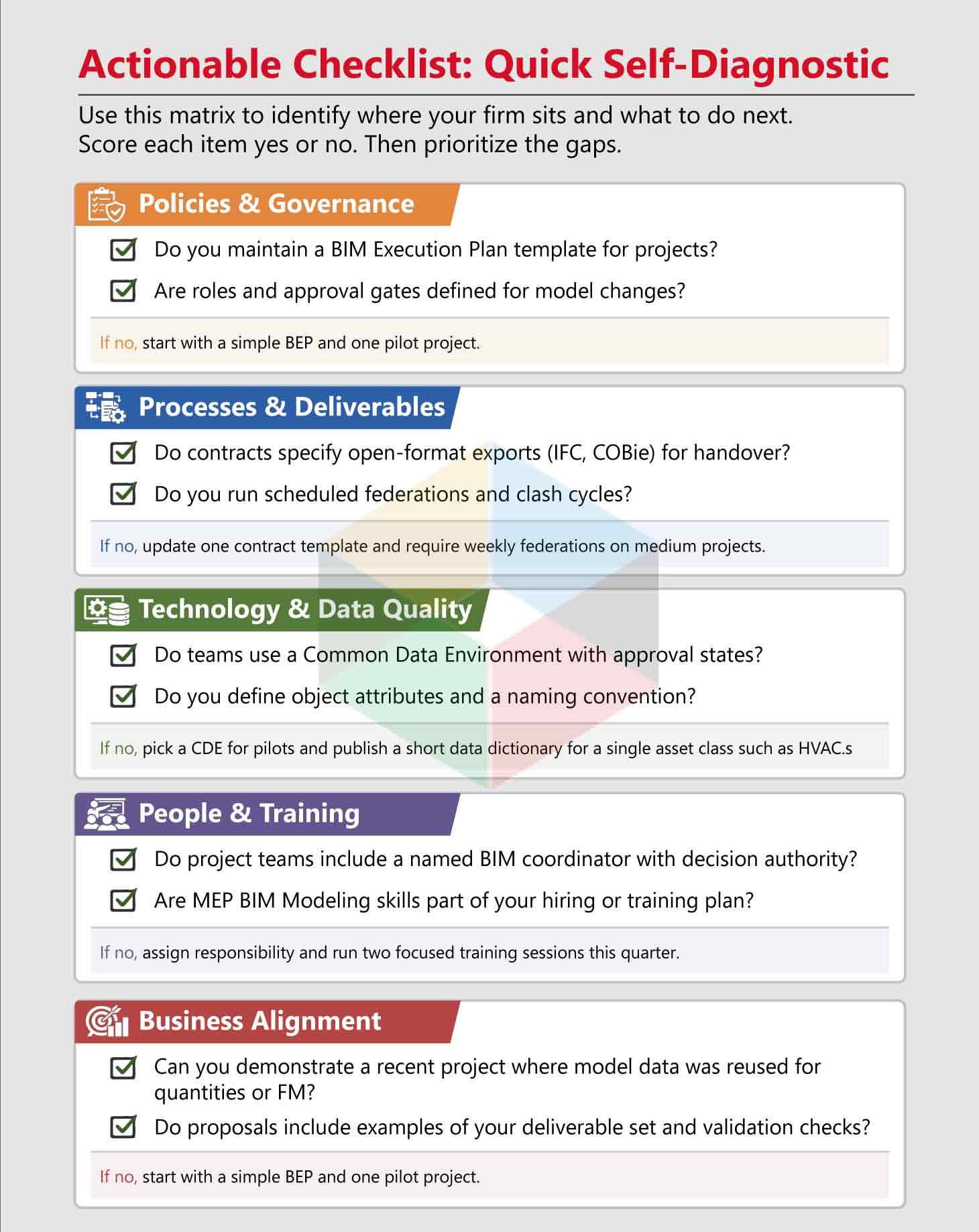
Completing these steps moves your firm from descriptive claims toward verifiable capability. If you need a short scope that describes deliverables for a Level 2-style contract or a checklist for MEP BIM Modeling handover, you can use this diagnostic as the starting point.
Conclusion
The Level 0-3 model helps teams describe a journey from drawing-centric workflows to integrated, information-driven delivery. That shorthand is useful, but US decision makers should treat it as a conversation starter rather than a contractual standard. Concrete capability measurement comes from standards and guidance such as the National BIM Standard-United States and federal owner guides, which let teams specify what a Level 2 or Level 3 deliverable actually looks like in practice.
If you lead a firm, prioritize Level 2 behaviors first. Publish a consistent BIM Execution Plan. Require weekly federations on medium and large projects. Specify open exports such as IFC and COBie for handover, and give your BIM coordinator decision authority over model approvals. These steps reduce rework and materially raise your Digital construction maturity.
Ready to stop firefighting coordination issues?