

MEP firms across the U.S. are under pressure from every direction at once. Project schedules are tighter. Coordination demands are heavier. Clients expect fewer RFIs and cleaner installs, even as fee compression continues. At the same time, internal drafting capacity has become harder and more expensive to maintain.
The problem isn’t a lack of engineering skill. It’s where that skill is being used. In many firms, licensed engineers and senior designers spend a significant portion of their week modeling, redlining, and managing production output. That work is necessary, but it doesn’t drive differentiation or growth. It also comes with rising fixed costs, including software licenses, hardware upgrades, training, and bench time when workloads dip.
MEP drafting services have quietly become one of the most outsourced production functions in the industry for this reason. Not as a cost-cutting experiment, but as a way to stabilize delivery while keeping technical authority in-house. Firms that separate design ownership from production execution are finding it easier to control schedules, reduce rework, and protect margins without increasing headcount.
Outsourcing, done poorly, creates risk. Done strategically, it reduces it. The difference lies in scope, process, and control.
This guide explains why outsourcing Revit MEP drafting services works when it’s treated as a structural business decision rather than a staffing fix. We will walk through the real cost of keeping drafting in-house, the measurable financial upside of outsourcing production, and how leading MEP firms are using hybrid models to scale without losing control.
Why Top MEP Firms Are Outsourcing Drafting Services and Why Your Firm Should Too
Outsource production tasks like BIM modeling services, drafting, clash-resolution support, and keep design and coordination in-house. That hybrid model gives you capacity on demand, lower fixed costs, and faster delivery without handing over design control.
Why In-House MEP Drafting Costs More Than You Think, and Not Just in Salary
What In-House MEP Drafting Actually Costs Your Firm
Salaries are the easiest line item to spot. But that is not the whole story.
In-House vs Outsourcing MEP Drafting Services
| Category | In-House MEP Drafting | Outsourced MEP Drafting |
|---|---|---|
| Total Cost Burden | High fixed costs: salaries + benefits + licenses + hardware + training + office overhead. Annual cost per drafter often $80k–$95k+ in the U.S. before overhead. | Variable cost model: pay per project/hourly. Outsourcing can reduce total drafting costs by 20 - 60% vs. in-house when adjusted for overhead. |
| Scalability & Flexibility | Limited; scaling requires hiring/redundancy or overtime during peak demand, which is costly. | Highly scalable; firms only pay for capacity needed, accelerating peak response without long hiring cycles. |
| Software & Tech Investment | Licenses (Revit MEP, AutoCAD), hardware, updates all paid by firm; major capital/renewal costs. | Included in service fee; partner carries license/tech costs, reducing capital expenditure. |
| Expertise & Skill Access | Dependent on hiring and training; may lack specialized BIM coordination skills without ongoing upskilling. | Access to specialized MEP BIM drafting experts with deep Revit and BIM coordination experience; often better at complex coordination tasks. |
| Quality & Risk Management | Full internal control; fast real-time adjustments. Risk of rework if staff lack advanced coordination expertise. | Often stronger quality control with advanced clash detection processes; some data shows outsourced BIM teams resolve 90% of clashes pre-construction. |
| Turnaround Time | Can stretch under heavy workload; bottlenecks slow projects. | Faster delivery from dedicated teams and round-the-clock workflows across time zones. |
| Collaboration & Communication | Immediate access to internal resources; easier real-time face-to-face coordination. | Requires defined protocols; modern cloud tools make coordination seamless when governance is strong. |
| Risk of Underutilization | High during slow periods. Skills sit idle but still cost money. | Low; capacity matches project load, reducing wasted labor expense. |
| Turnover & Talent Retention Impact | Hiring and retaining talent is competitive; turnover can disrupt continuity. | Outsourced teams absorb turnover risk; staffing continuity managed by partner. |
- According to ZipRecruiter’s January 2026 data, the average Revit MEP designer in the U.S. earns about $88,079/year, i.e., $7,339/month.
- Add software licenses, workstation hardware, benefits, recruiting, and management overhead and that $7.3k climbs fast. Whereas licenses alone can be several hundred dollars per seat monthly.
Training matters. Autodesk’s certification guidance notes that candidates typically need 400–1,200 hours of real-world Revit experience to reach certification-level competence.
That’s weeks to many months of productive drag while junior staff learn your standards.
The Opportunity Cost of Labor Scarcity
Talent scarcity is not myth. According to Deloitte’s 2024 Engineering & Construction outlook, 68% of firms report difficulty filling open positions, so hiring is slow and expensive. The Associated Builders and Contractors reported a construction workforce gap exceeding half a million workers in 2024.
So you can pay market premiums and still face long ramp times. Or you can buy finished capacity from a partner.
The Rework Penalty
Rework is expensive. Research finds that the direct costs of rework average around 5% of total construction costs. Other industry analyses give broader bands, such as 5–15% of project value lost to rework on some projects, depending on project complexity and control processes.
On a $10M project, even a 5% rework exposure is $500k. That’s not a rounding error.

Why Outsourcing MEP Drafting Services Delivers Measurable ROI - Cost, Time, and Quality
Cost Savings You Can Measure and Control
When you outsource MEP BIM drafting services, you stop carrying the full fixed cost of staff and software. Multiple provider case studies and market writeups show typical outsourcing savings between 20 - 40% compared with fully-burdened in-house costs, mostly by removing recruiting, training, and license overhead.
Time Savings That Protect Your Schedule
Outsourcing teams arrive with proven workflows and Revit MEP experience. Studies and vendor case reports show BIM-enabled coordination often shortens delivery cycles 20–40% and can enable earlier prefab or shop drawing sign-offs which in turn shortens site schedule.
Faster drawings lead to earlier procurement, earlier fabrication, and fewer on-site delays.
Quality Gains That Reduce Risk
BIM clash detection using Navisworks, Revizto, or native Revit checks catches most spatial conflicts long before crews cut pipe. Many BIM-coordinated projects see 20–50 % lower rework costs compared with traditional drafting and coordination workflows.
Outsourcing to a partner that follows ISO 19650 workflows and documented QA/QC reduces information risk, which mean fewer surprises in the field.
Common Objections to MEP Outsourcing Addressed
“Won’t we lose control over quality?”
Not if you write the SOW (Scope of Work). Require Revit templates, element naming, Level of Development (LOD) expectations, deliverable formats, and QA steps up front. Contractual KPIs and sample deliverables protect you, and the right partner will welcome those gates.
“Communication will slow down if they’re offshore.”
Cloud platforms make geography transparent. With a central Common Data Environment (BIM 360 / Autodesk Construction Cloud or similar) and a 1–2 hour overlap window, your local PM still controls approvals. Also, a 24-hour model cycle can become an advantage. Overnight work equals the next-day deliverable in your time zone.
“They won’t understand our standards and codes.”
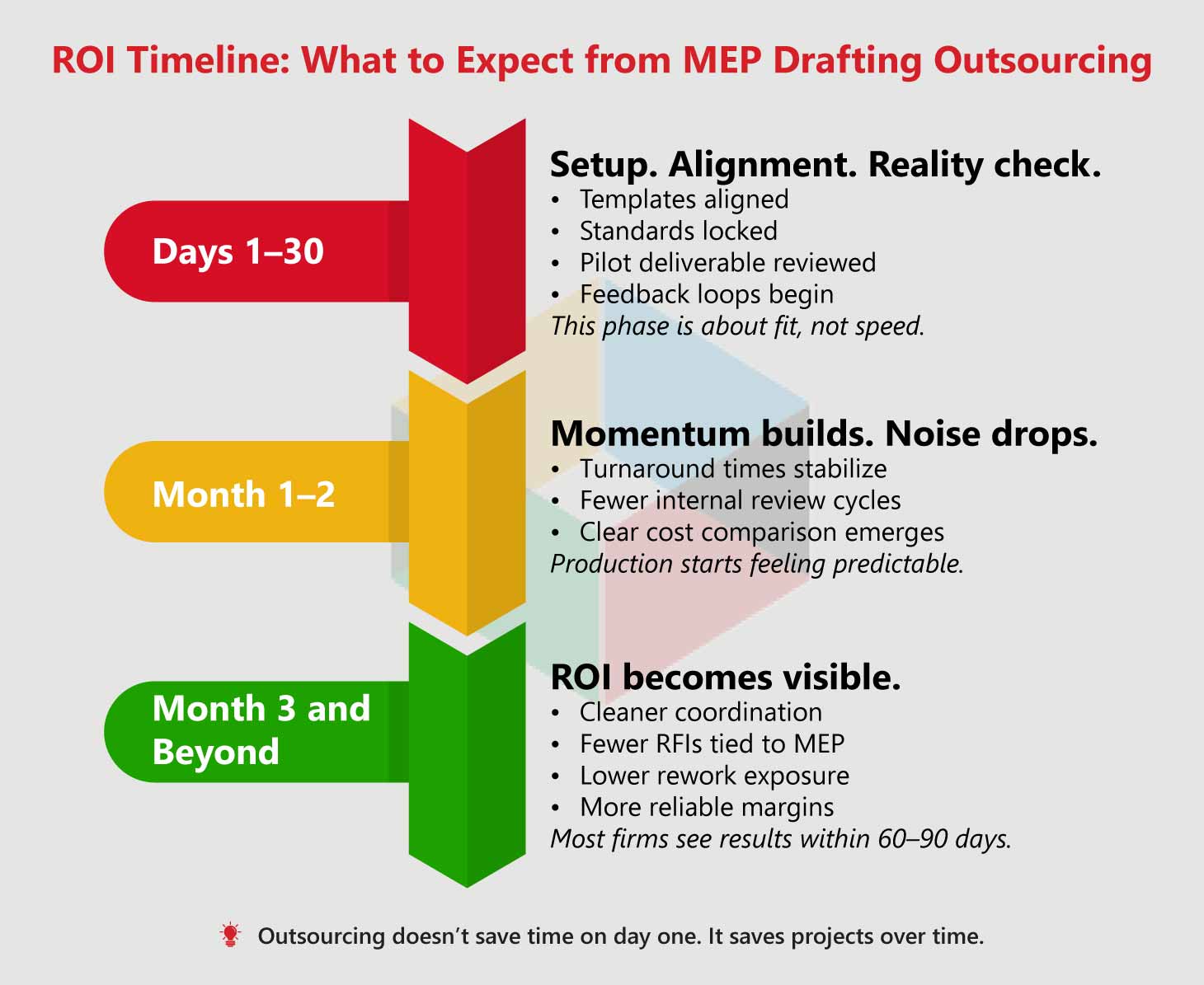
Onboarding matters. Require a knowledge-transfer sprint. One paid or free pilot where your templates, code checklist, and typical comments are reviewed. Good partners document everything, so the second project runs faster.
How to Choose the Right MEP Outsourcing Partner
Technical Must-Haves: Certifications & Specialized Expertise
- Revit MEP certified staff; Autodesk badges are non-negotiable.
- Demonstrable experience with projects of your type, like healthcare, industrial, residential, etc.
- ISO 19650 or equivalent information-management workflows.
Process, Quality, & Communication
- Clear SOW, SLAs, revision cycles, and IP clauses.
- Access to a CDE and model-level QA logs so you can audit.
- References with verifiable numbers like time saved, rework reduced, or margin preserved.
What to Ask References: Proven Track Record & Portfolio
- How fast did they reach your productivity baseline?
- Give me one example of a clash they caught that we would have missed.
- Did their deliverables reduce RFIs or field stoppages?
Three Quick, Actionable Takeaways for Decision Makers
Map capacity before you add people.
Look at real utilization, not headcount. If your core MEP team is consistently above 80–85% utilization, quality will slip before schedules do. That’s the signal to outsource production work, not to stretch your staff further.
Start with a paid pilot, not a promise.
Pick one live package. Define turnaround time, clash expectations, and revision limits upfront. Measure how many review cycles it takes to reach approval. That tells you more than any sales call ever will.
Lock standards early or pay later.
Templates, LOD, naming rules, and coordination protocols must be documented before scale. When standards are clear, outsourced teams move fast. When they are not, every revision becomes friction.
Conclusion
Outsourcing Revit MEP drafting services isn’t a band-aid. It’s a way to buy skilled, measurable capacity while you protect margins and schedules. Given the workforce tightness, hiring alone will not solve your short-term bottlenecks.
We are not saying outsourcing is risk-free. It introduces governance and handover work. But when done with a clear SOW, pilot, and KPI set, it shifts cost from fixed to variable, compresses schedules, and cuts exposure to rework, generally in measurable ways.
Ready to test the outsourcing partner?
Start with a 2-week pilot project:
- One set of coordinated shop drawings
- One set of clash reports
- One after-action review
If that pilot saves you a single day on critical path or cuts one costly site rework, it has already paid back.